
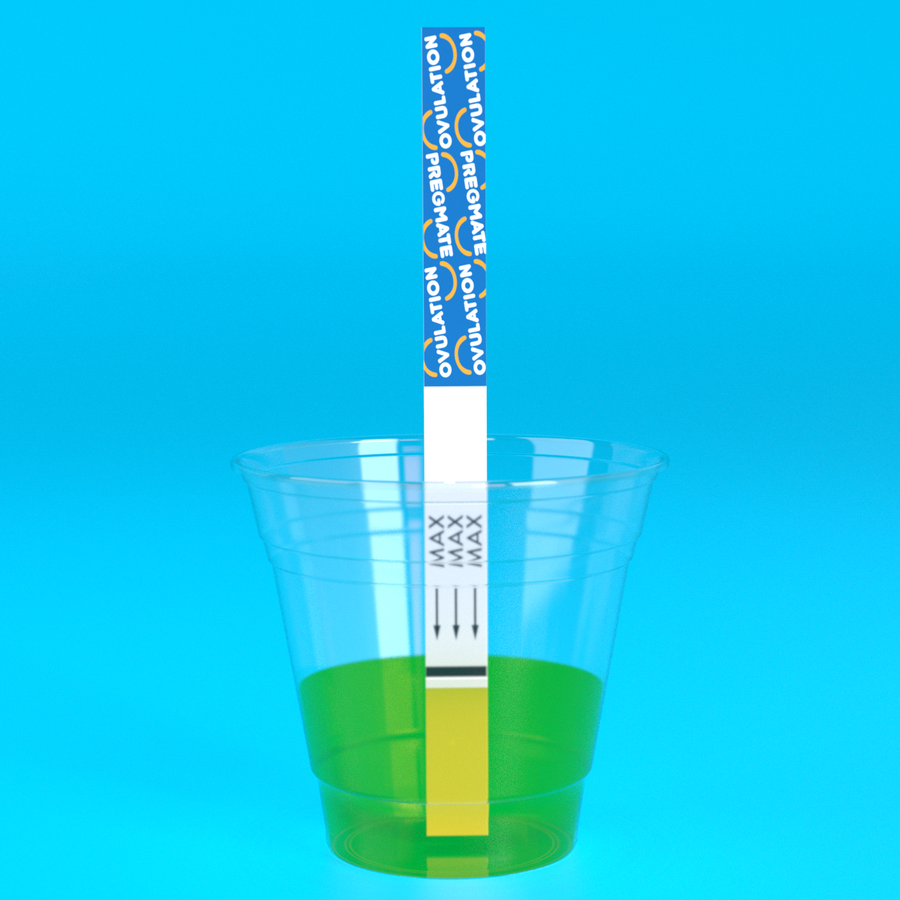
- Start testing on the right cycle day. Subtract 17 from your cycle length to find your start day. For a 28-day cycle, that's Day 11. For shorter or longer cycles, adjust accordingly.
- Test between 10 AM and 8 PM. Mid-afternoon (2–5 PM) is ideal. Don’t use first morning urine: it was made overnight, often before your LH surge began.
- Hold your pee for 2 hours before testing. Don't overhydrate in those 2 hours. Your urine should be medium yellow, not clear.
- Read your result at 5 minutes, and don’t read it later. It’s positive when the test line is as dark as the control line or darker.
- Test daily until positive. Once you see a clear positive, you can stop: that’s your surge. Have sex that day and the next. If you have short or irregular cycles, test twice a day (10 AM and 6 PM).
When to start testing in your cycle
Day 1 is the first day of your period. To find your start day, subtract 17 from your cycle length.
| Cycle length | Start testing on | Estimated ovulation |
|---|---|---|
| 21 days | Day 4–5 | Day 7 |
| 24 days | Day 7–8 | Day 10 |
| 26 days | Day 9–10 | Day 12 |
| 28 days | Day 10–11 | Day 14 |
| 30 days | Day 12–13 | Day 16 |
| 32 days | Day 14–15 | Day 18 |
| 35 days | Day 17–18 | Day 21 |
Test once daily until you get a positive or your period starts.
Irregular cycles? Use your shortest recent cycle to calculate your start day. If you don’t know your cycle length yet, begin on day 11, as the Pregmate instructions advise. For a full guide, see when to start testing.

What is the best time of day to take an ovulation test?
The ideal testing window is 10 AM to 8 PM. Here's why each time works:
| Time of Day | Effectiveness | Notes |
|---|---|---|
| First morning urine (5 AM - 7 AM) | Poor | Urine was made overnight before surge began |
| Mid-morning (10 AM - 12 PM) | ✅ Good | Catches surges that began early morning |
| Afternoon (2 PM - 5 PM) | ✅ Excellent | Often the most reliable time |
| Evening (6 PM - 8 PM) | ✅ Good | Still effective; later cutoff helps consistency |
| Late night (9 PM - 12 AM) | Okay | Works but less consistent; urine may be diluted |
Should you test at the same time every day?
Yes, if possible. Consistency helps you compare results. If you test at 2 PM every day, you can see the progression from negative → faint line → dark positive more clearly.
However, don't stress if you can't test at exactly the same time. Testing at 11 AM one day and 4 PM the next is fine, as long as you're within the 10 AM - 8 PM window, you'll catch your surge.
Pick your testing time
Choose a time that fits your schedule and stick with it:
- Work from home? Test at 2 PM after lunch
- 9-5 office job? Test at 10 AM before work or 6 PM after
- Night shift? Test during your "afternoon" (midpoint of your waking hours)
Set a daily reminder on your phone so you don't forget.
Test anywhere from 10 AM to 8 PM. Afternoon (2-5 PM) is ideal. Stay consistent if you can, but don't stress if your timing varies by a few hours.
Why you should NOT use first morning urine for ovulation tests
First morning urine (FMU) works perfectly for pregnancy tests, but it's problematic for ovulation tests. Here's why:
How LH surges work (and why timing matters)
Your pituitary gland releases a surge of luteinizing hormone (LH) 24-36 hours before ovulation. This surge:
- Often begins in the early morning: research shows the LH surge most often starts in the early morning hours.
- Takes hours to appear in urine: LH from your blood needs a few hours to build up in urine.
- Easier to detect later in the day: that’s why late morning to evening urine is more likely to catch it.
The problem with first morning urine: That urine collected overnight, often before your LH surge began. Even if your surge started at 6 AM, your first morning pee may not show it yet.
Can LH surges happen at night?
Yes, but it's less common. Studies show that approximately 70% of LH surges begin in the morning (4 AM - 12 PM), with the remaining 30% starting afternoon or evening. This is why afternoon testing catches the majority of surges.
LH surge pattern: Why afternoon testing works best

Should you test twice a day?
For most women, once-daily testing is sufficient. But consider testing twice daily (12 hours apart) if:
- You have short or irregular cycles: Your LH surge may be brief (10-14 hours), and once-daily testing could miss it
- You've tested for 3+ cycles and never got a positive: You might be catching the tail end or missing the peak
- You're using expensive treatments (IUI, IVF): Precision matters more when timing is critical
Best times for twice-daily testing
10 AM and 6 PM (8 hours apart, easier schedule) or 10 AM and 10 PM (12 hours apart, better coverage)
Twice-daily testing significantly increases your chances of catching short surges, but it also means using twice as many tests. Pregmate's affordable strip tests make this feasible without breaking the bank.
How long to hold pee before taking an ovulation test
For accurate results, follow these guidelines:
1. Hold your urine for 2 hours
Don't pee for 2 hours before testing. This allows LH to concentrate in your bladder. If you pee every hour, your urine is too diluted and may not show LH even if it's surging.
Example timeline:
12:00 PM — Last pee
2:00 PM — Test (2-hour hold)
2. Limit water intake for 2 hours before testing
Don't chug water before testing. Excessive hydration dilutes your urine, which dilutes LH concentration.
What's "excessive"? Drinking more than 8-12 oz of water in the 2 hours before testing. Normal sips are fine—just don't drain a water bottle.
3. Check your urine color
Your urine should be medium yellow—not clear/pale and not dark. If it's very pale or clear, your urine is too diluted. Wait 30-60 minutes and test again.
If you're getting faint lines or negative tests but think you should be ovulating, check your hydration. Women who drink 3+ liters of water daily or who test right after drinking a large glass of water often get false negatives.
Fix: Hold pee for 3 hours instead of 2, or test first thing after waking from a nap (if you didn't drink water beforehand).
Don't pee for 2 hours before testing. Don't chug water for 2 hours before. Your pee should be medium yellow, not clear. These steps concentrate LH so the test can detect it.
Technical details: dipping, reading, and storing tests
How long to wait before reading results
Read at 5 minutes. Most ovulation tests stabilize at 3-10 minutes, but 5 minutes is the sweet spot according to clinical validation studies on LH detection methods:
- Before 3 minutes: Lines may still be developing
- At 5 minutes: Results are stable and accurate
- After 10 minutes: Evaporation lines can appear, causing confusion
Set a timer when you dip the test. Read it at exactly 5 minutes, then discard it to avoid second-guessing results later.
Does urine need to be room temperature?
No. You can test immediately after collecting urine—you don't need to let it cool or warm up. Fresh urine at body temperature works perfectly.
Some women prefer to let urine sit for 1-2 minutes if it's very fresh (straight from the body), as this can make lines easier to read, but it's not required.
Can you reuse urine from earlier?
Not recommended. LH can degrade in urine over time. If you must save urine (e.g., testing multiple brands), refrigerate it and use it within 2-4 hours. Bring it to room temperature before testing.
Special situations: night shifts, PMOS (PCOS), and short surges
What if you work night shifts?
Test during your "afternoon": the midpoint of your waking hours, not calendar time.
Example schedule:
You sleep 8 AM - 4 PM
You wake at 4 PM
Your "afternoon" is around 10 PM - 12 AM
Test at 10 PM (midpoint of your waking hours)
Avoid testing right after waking (your first pee) for the same reason: that urine was made while you were sleeping, before any surge began.
What if you have PMOS (PCOS)?
PMOS (formerly PCOS) can complicate ovulation testing. For a full guide, see ovulation tests with PMOS:
- Elevated baseline LH: Some women with PCOS have LH levels that are always somewhat elevated, causing faint lines every day
- Multiple surges without ovulation: LH may spike but not trigger egg release
- Irregular cycles: You may not know when to start testing
Strategy:
- Start testing on Day 8 and test daily (or twice daily) until positive or period starts
- Look for a test line that's as dark or darker than the control line — not just "darker than yesterday"
- Confirm ovulation with basal body temperature (BBT) tracking to see if the surge actually resulted in ovulation
- Consider using advanced digital tests that measure both estrogen and LH
What if you never get a positive?
If you've tested for 3+ cycles and never seen a positive result:
- Check your testing time: Are you using first morning urine? Switch to afternoon
- Test twice daily: Your surge may be very short (10-12 hours)
- Watch the T/C ratio: if you scan your strips, a ratio that climbs toward 0.8–1.0 and then drops may still be your surge. More on reading T/C.
- See your doctor: you may not be ovulating every cycle. Blood tests can check this. If your cycles are irregular, talk to a doctor now.
Frequently asked questions
Can you use first morning urine for an ovulation test?
No, it's not recommended. First morning urine was produced overnight before your LH surge began, so it won't show elevated LH even if you're surging. Test between 10 AM - 8 PM for best results.
What time of day is LH highest in urine?
LH is typically highest in the urine between 10 AM - 8 PM, with peak levels often occurring around 2 PM - 6 PM. This is because LH surges begin in the early morning, and it takes 3-4 hours for hormones to show up in urine at detectable levels.
How long should you hold your pee for an ovulation test?
Hold your urine for at least 2 hours before testing. This allows LH to concentrate in your bladder. Also avoid drinking excessive water for 2 hours before testing—normal hydration is fine, but don't chug water or your urine will be too diluted.
Can you take an ovulation test at night?
Yes, evening testing (6 PM - 8 PM) works well. Late night (9 PM - midnight) is okay but less ideal because urine may be more diluted. Avoid testing right before bed if you've been drinking fluids throughout the evening.
Complete timing checklist
- Test between 10 AM - 8 PM (afternoon 2-5 PM is ideal)
- Hold pee for 2 hours before testing
- Don't drink excessive water 2 hours before
- Check urine color (medium yellow, not clear)
- Dip test for 3-5 seconds
- Read result at 5 minutes
- Test at the same time daily if possible
- DON'T use first morning urine
- DON'T test right after drinking lots of water
Sources
- Ecochard, R., Duterque, O., Leiva, R., Bouchard, T., & Vigil, P. (2015). "Self-identification of the clinical fertile window and the ovulation period." Fertility and Sterility, 103(5), 1319-1325. https://doi.org/10.1016/j.fertnstert.2015.01.031 Study on timing of LH surges and optimal testing windows for ovulation detection.
- Johnson, S., Weddell, S., Godbert, S., Freundl, G., Roos, J., & Gnoth, C. (2015). "Development of the first urinary reproductive hormone ranges referenced to independently determined ovulation day." Clinical Chemistry and Laboratory Medicine, 53(7), 1099-1108. https://doi.org/10.1515/cclm-2014-1087 Established urinary LH thresholds and optimal timing for detection based on ovulation day.
- Su, H.W., Yi, Y.C., Wei, T.Y., Chang, T.C., & Cheng, C.M. (2017). "Detection of ovulation, a review of currently available methods." Bioengineering & Translational Medicine, 2(3), 238-246. https://doi.org/10.1002/btm2.10058 Comprehensive review of ovulation detection methods including LH testing accuracy and timing protocols.
- American Society for Reproductive Medicine (ASRM). (2023). "Optimizing Natural Fertility: A Committee Opinion." ASRM Practice Guidelines Clinical guidelines on fertility awareness methods and optimal timing for conception.
- McGovern, P.G., Myers, E.R., Silva, S., et al. (2004). "Absence of secretory endometrium after false-positive home urine luteinizing hormone testing." Fertility and Sterility, 82(5), 1273-1277. https://doi.org/10.1016/j.fertnstert.2004.04.070 Research on LH surge detection accuracy and factors affecting test reliability including timing and urine concentration.
This article is for informational purposes only. Ovulation tests are tools to help identify your fertile window but should not replace consultation with a healthcare provider.
If you have irregular cycles, PCOS, or have been trying to conceive for 12 months (or 6 months if over 35) without success, please consult a reproductive endocrinologist or OB-GYN.


