
Compare the test line to the control line.
Positive ovulation test: Test line is equal to or darker than the control line. You will ovulate within 12-36 hours.
Negative ovulation test: Test line is lighter than the control line, or no test line appears. Your LH surge hasn't started yet.

-
Bottom test: NEGATIVE - Test line lighter than control (faint or no line visible)
-
Middle test: CLOSE - Test line almost as dark as control (test again in 4-6 hours for your positive). "Close" means you're approaching your LH surge - usually within 12-24 hours of a positive.
-
Top test: POSITIVE - Test line equal to or darker than control (ovulate in 12-36 hours)
Positive ovulation test: Test line equal to or darker than control line.
Negative ovulation test: Test line lighter than control or no line visible.
Ovulation test result examples
 Negative ovulation test: Test line is faint/absent - keep testing daily
Positive ovulation test: Test line matches control - have intercourse now

Positive ovulation test (Peak): Test line darker than control - peak LH surge
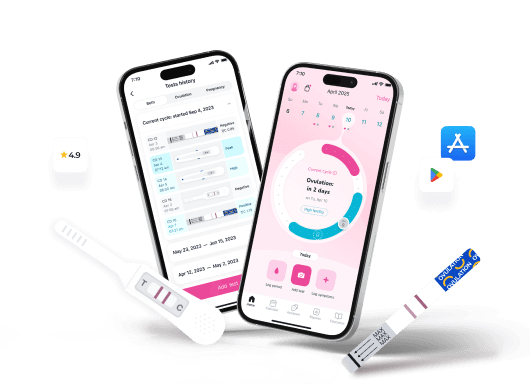
5-Day test progression in Pregmate app![]()

CD 11: Rising LH (The test line is dark but still slightly lighter than the control).
CD 12: FIRST POSITIVE (The test line is darker than the control; this marks the start of the LH surge).
CD 13: PEAK (Maximum LH concentration; the test line is significantly darker than the control).
CD 14: Surge Fading (The test line is lighter than the control as hormone levels drop).
CD 15: Negative (The test line is faint, indicating a return to baseline levels).
T/C Ratio: objective line measurement
The T/C ratio (Test line to Control line ratio) is a way to objectively measure line darkness:
-
T/C = 0.4: Test line at 40% darkness → Negative
-
T/C = 0.9: Test line at 90% darkness → Close (test again soon!)
-
T/C = 1.0: Test line equals control → Positive
-
T/C = 1.2+: Test line darker than control → Peak positive
The Pregmate app scanner calculates T/C ratio automatically to remove guesswork.
Common mistakes to avoid
|
❌ Wrong timing |
✅ Correct method |
|
|
Common questions about ovulation tests
What does a positive ovulation test look like?
A positive ovulation test has a test line that is as dark as or darker than the control line. Even if it's just barely as dark, it's positive. This means you will ovulate within 12-36 hours.
What does a negative ovulation test look like?
A negative ovulation test has a test line that is lighter than the control line, or no test line at all. Only the control line should be dark. This means your LH surge hasn't started yet.
How do I know if my ovulation test is positive?
Compare the test line to the control line. If they're equal darkness or the test line is darker, you're positive. If you're unsure, use the Pregmate app scanner for objective T/C ratio analysis, or test again in 4-6 hours.
What if the test line is almost as dark as the control?
This is called "close" or "high" - you're approaching your LH surge. Test again in 4-6 hours. You'll likely see a positive (equal or darker) on your next test.
Can I get a positive ovulation test on the day I ovulate?
Your LH surge happens 12-36 hours BEFORE ovulation, not on ovulation day. So a positive test means you're about to ovulate, not that you're currently ovulating. Have intercourse as soon as you get a positive.
Why do I never get a positive ovulation test?
Common reasons:
- Testing at wrong time (use afternoon, not morning urine)
- Testing once daily and missing brief surge (test 2x when close)
- Short LH surge (test more frequently)
- Anovulatory cycle (no ovulation that month)
Best practice: Test between 10 AM - 8 PM twice daily for best results.
Sources and references
-
Park, S.J., Goldsmith, L.T., & Weiss, G. (2007). "Characteristics of the urinary luteinizing hormone surge in young ovulatory women." Fertility and Sterility, 88(3), 684-690. https://doi.org/10.1016/j.fertnstert.2007.01.045 Study on LH surge patterns and timing relative to ovulation.
-
Johnson, S., Weddell, S., Godbert, S., et al. (2015). "Development of the first urinary reproductive hormone ranges referenced to independently determined ovulation day." Clinical Chemistry and Laboratory Medicine, 53(7), 1099-1108. https://doi.org/10.1515/cclm-2014-1087 Established urinary LH thresholds and reference ranges for ovulation prediction.
2 comments
I take my ovulation test still positive test
What if both lines are the same but light?