
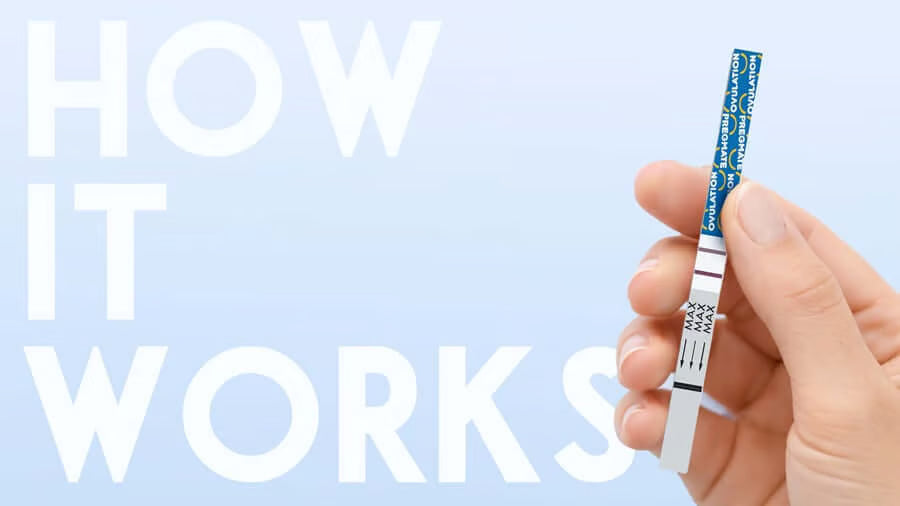
- Ovulation tests detect the LH surge that happens about 24–36 hours before ovulation, showing your most fertile window.
- A result is positive when the test line is as dark as or darker than the control line; a faint line is still a negative.
- Test once a day between late morning and evening, avoiding excess fluids for about 2 hours beforehand.
- Start testing a few days before expected ovulation and consider testing twice daily if your LH surge is short or easy to miss.
- Ovulation tests are highly accurate for detecting LH, but they cannot confirm that ovulation or pregnancy actually occurred.
How ovulation tests work
Ovulation predictor kits (OPKs) detect luteinizing hormone (LH) in your urine. LH is produced by your pituitary gland and is always present at low levels throughout your cycle. About 24–36 hours before ovulation, LH surges dramatically. This surge is your body's signal that a mature egg is ready to be released from the ovary.
The LH spike triggers ovulation — the release of an egg from your ovary. Ovulation is your most fertile time of the month. Detecting the LH surge helps you identify your fertile window and time intercourse for the best chance of conception.
Ovulation tests contain special antibodies that react to LH in urine. When your LH level rises above a certain threshold, the test shows a positive result, usually as a colored line or digital symbol. A positive ovulation test means an LH surge has been detected, indicating you're likely to ovulate within the next 24–36 hours.
Ovulation tests detect the LH surge about 9 times out of 10 when used carefully, according to the FDA. However, they cannot confirm that ovulation actually occurred — they only indicate that your body is attempting to ovulate.

Hormone guide for ovulation and fertility:
| Hormone | What it does | What it means for fertility |
|---|---|---|
| LH (Luteinizing Hormone) | Triggers egg release from ovary | Surge indicates ovulation is coming in 24–36 hours |
| Estrogen | Builds uterine lining, stimulates LH surge | Rising levels mean you're approaching ovulation |
| Progesterone | Maintains uterine lining after ovulation | Rises after ovulation; supports early pregnancy |
| FSH (Follicle-Stimulating Hormone) | Helps eggs mature in ovaries | Present throughout cycle; needed for follicle development |
When to take an ovulation test (best time of day)
Timing makes a significant difference in getting accurate results from ovulation tests. Unlike pregnancy tests, which should be done with the first morning urine, ovulation tests have different requirements for optimal accuracy.
Morning vs night
You can take an ovulation test at any time of day, but consistency matters. Pick a convenient time and test around that same time each day as you approach ovulation. Late morning to early evening is ideal for LH testing.
LH can rise quickly, and it may take a few hours to show up in urine. An LH surge that begins in the morning might not be detectable in urine until later in the day. Many experts note that mid-afternoon (around 2 PM) may be optimal for many women. If afternoon testing isn't practical, early evening also works well.
Can you use first morning urine?

First morning urine is not recommended for ovulation tests. While it's ideal for pregnancy tests, it's less reliable for LH detection. LH tends to surge during the day, often starting in the early morning hours and peaking in the late morning or afternoon.
By the time you wake up, your first urine may not yet contain the day's LH peak. Using first morning urine could cause you to miss the start of your LH spike.
Best time window (with explanation)
Most healthcare providers suggest testing between late morning and early evening, roughly 10 AM to 8 PM for best results. Within this window, early afternoon is often ideal.
- Avoid excessive fluids before testing. Don't drink large amounts of water or other liquids in the two-hour period prior to your test. Too much fluid dilutes your urine and makes it harder for the test to detect LH.
- Test around the same time daily. If you test today at 2 PM, test tomorrow at roughly 2 PM as well. This creates a stable routine and reduces the chance of missing a sudden surge.
How to use ovulation test strips
Using an ovulation test is straightforward, but following directions carefully ensures accurate results.
- Hold urine for ~2 hours before testing.
- Limit fluids for ~2 hours beforehand (don't overhydrate).
- Dip the strip into urine up to the MAX line for 5 seconds.
- Lay the strip flat on a clean, dry surface.
- Read at 5 minutes. Don’t read the result after 5 minutes.
- Compare the test line to the control line.

Common mistakes to avoid
- Testing with very dilute urine (can mask the surge).
- Reading too early or after 5 minutes (evaporation lines can mislead).
- Stopping too soon before your expected window is over.
- Judging results by eye alone. Lighting and timing can affect how lines appear. Using the Pregmate App to scan and track results helps reduce misreading and spot real patterns over time.
Once a day vs twice a day
Most people can test once daily. If your LH surge is brief (sometimes 12–24 hours), testing twice daily during your predicted window can reduce the chance of missing it.
How to read ovulation test results
Reading an ovulation test is straightforward once you know what to look for. Most ovulation test strips have two lines: a control line and a test line. The control line indicates the test worked properly. The test line indicates the presence of LH in your urine.

Positive vs negative (the clear rule)
Positive: The test line is as dark as or darker than the control line. This means your LH surge has been detected. You will likely ovulate within the next 24–36 hours. Some digital ovulation tests show a smiley face or another symbol when positive.
Negative: No second line appears, or the test line is visibly lighter than the control line. The test is considered negative for the surge. A negative test suggests you're not yet in your LH surge phase (or you've already ovulated and the surge has passed).
A negative test doesn't mean no LH at all — it just means LH is at normal low levels, below the surge threshold.
Two lines: what if one is lighter?
A faint test line is not a positive result. Because LH is always in your system at low levels, many women see a faint second line on their ovulation tests on most days. As long as that test line is lighter than the control line, the result is considered negative.
For example, you might test on Cycle Day 10 and see a faint second line. That just means a small amount of LH was detected, but not a surge. The next day, the line might get darker. Eventually, on the day of your LH surge, the test line will match the control line in darkness (or even exceed it). After ovulation, the line typically fades to a lighter shade again as LH levels drop.
If one line is lighter than the other, the ovulation test is negative. Continue testing until the test line becomes as dark as the control line.

How dark is "positive"?
The test line must be at least as dark as the control line. Even slightly lighter means the test is still negative. When the lines are equal in darkness or the test line is darker, you've detected your LH surge.
Don't try to interpret shades of darkness beyond this rule. Either the lines match in intensity or they don't.
Digital ovulation tests give a clear positive indicator (like a smiley face) when LH is surging, so you don't have to compare lines. They're more expensive, but many women use inexpensive strip tests for daily testing and a digital test to confirm.

When to read the result (the 5-minute rule)
Read your results at 5 minutes after taking the test. Results read later than that are not reliable. The test continues to develop as it dries, which can create false lines or darken existing lines.
Set a timer. Check the result within the valid time window and then discard the test.
Can an ovulation test be positive if you're pregnant?
Yes, it's possible for an ovulation test to show positive results during pregnancy, but ovulation tests should not be used as reliable pregnancy tests.
Ovulation tests detect the LH hormone, but the pregnancy hormone hCG (human chorionic gonadotropin) is very similar in structure to LH. Some ovulation tests aren't specific enough to perfectly distinguish between LH and hCG.
Why this can happen
When you become pregnant, hCG levels start to rise, especially after the embryo implants (around 8–10 days after ovulation). An OPK is designed to react strongly to LH, but hCG can trigger the test as well. A pregnant person's urine could cause a test line to appear on an ovulation kit.
When it is most likely
This typically only happens once hCG is fairly elevated — usually after the time of a missed period. Early in pregnancy, hCG may not be high enough to turn an ovulation test positive.
If you are very early in your pregnancy and still taking ovulation tests, you might notice the tests stay positive every day instead of just once. That could be a clue.
If you get a string of unexpected positive ovulation tests and pregnancy is a possibility, take a pregnancy test for confirmation. Pregnancy tests are designed to specifically detect hCG and are the reliable way to confirm pregnancy.
Ovulation tests detect LH and can react to hCG. Pregnancy tests detect only hCG and are the reliable way to confirm pregnancy.
When to start testing for ovulation
Knowing when to begin using ovulation tests is crucial. The start day depends on the length of your menstrual cycle. Start testing a couple of days before the earliest likely day of ovulation. Ovulation usually happens about 14 days before your next period.
Regular cycles
If you know your average cycle length, use this reference guide. Day 1 is the first day of your period.
| Cycle Length | When to Start Testing | Days to Test |
|---|---|---|
| 21 days | Day 5 of cycle | 5–7 days |
| 25 days | Day 9 of cycle | 6–7 days |
| 28 days | Day 11 or 12 of cycle | 6–8 days |
| 30 days | Day 13 or 14 of cycle | 7–9 days |
| 35 days | Day 18 or 19 of cycle | 8–10 days |

Irregular cycles
Irregular cycles make it trickier to predict ovulation. Use the shortest cycle you've had in recent months as a baseline for when to start. Start testing earlier and plan to test for more days — you may need to test for 2–3 weeks.
Another approach is to watch your body's signs of fertility, particularly cervical mucus changes. As ovulation approaches, cervical mucus often becomes clear, stretchy, and egg-white-like. Begin testing when you notice fertile mucus starting to increase.
After your period
For a typical 28-day cycle, you'd likely start around day 11 or 12, which is roughly a week after a 5-day period ends. If you have a short cycle, it's possible to ovulate soon after your period, so you'd start testing just a day or two after menstrual bleeding stops.
How many days to test
Continue testing until you get a positive or until you're past the expected window of ovulation. Have a few extra tests on hand in case ovulation is earlier or later than average.
How often should you test?
The frequency of testing depends on how precise you want to be and how quickly your LH surge comes and goes.
Once per day
Testing once a day is sufficient to catch the LH surge for most people. If you test at roughly the same time each day (for example, every afternoon), an LH surge that lasts over a day will be picked up on one of those daily tests.
Twice per day around ovulation
If you want to maximize your chances of catching a short LH surge, test twice a day as you get near expected ovulation. In some cases, the LH surge can be brief — sometimes around 12 hours in duration. In case you only test every 24 hours, it's possible to miss the peak entirely if it starts and ends between your tests.
Cost vs benefit
Using more tests (twice daily) will use up your supply faster. If you're using inexpensive test strips, this usually isn't a big problem. Some people combine methods — using inexpensive strips twice a day, and confirming with a digital test when the strip looks close to positive.
Start with testing once per day as you approach ovulation. If you want extra assurance — or if your past experience suggests you might be missing the surge — consider testing twice a day in your predicted fertile window.
Accuracy, false positives, and limitations
Ovulation predictor kits are highly accurate at detecting an LH surge. Manufacturers often report around 99% accuracy in lab testing. In everyday use, the FDA says the tests detect LH reliably about 9 times out of 10.
What "99% accurate" actually means
The 99% accuracy figure refers to the test's ability to sense LH changes in urine under laboratory conditions. It doesn't mean 99% accurate in predicting pregnancy or guaranteeing ovulation. An OPK tells you that your body is having an LH surge, but it cannot confirm that ovulation actually occurred. Only methods like ultrasound tracking, a basal body temperature rise, or a progesterone blood test can confirm that an egg was released.
False positives can happen with:
- PMOS / PCOS (Polycystic Ovary Syndrome): Women with PCOS often have chronically elevated LH levels or multiple smaller LH surges. This can cause ovulation tests to show positive results several times in a cycle when no ovulation follows.
- Certain fertility medications: If you're taking fertility drugs like menotropins, which contain LH, or if you've had an hCG trigger shot, an ovulation test can turn positive because of those hormones in your system. Always consult your physician about using ovulation tests if you're undergoing fertility treatments.
- Pregnancy: If you're actually pregnant, the hCG might cause a positive OPK.
- Perimenopause or menopause: Women approaching menopause can have elevated LH levels, which could cause an ovulation test to appear positive at odd times.
False negatives
A false negative can happen if you missed the surge timing, if your urine was too dilute to detect LH, or if your LH surge is naturally low in amplitude. Some women's peak LH might not reach the threshold of certain tests. Using a more sensitive ovulation test or testing multiple times a day can help.
Limitations
If you have PCOS, are on certain hormonal medications, or have recently been pregnant or breastfeeding, the OPK may not perform as expected. As women approach menopause, cycles can become irregular and LH levels can be erratic.
What to do after a positive ovulation test
A positive ovulation test means you're in your fertile window right now. Ovulation typically occurs 24–36 hours after the LH surge begins.
Timing intercourse
Plan to have sex within the next 24–36 hours if you're aiming to conceive. For good measure, it's often recommended to have intercourse the day of the positive test and the following day.
Sperm can survive for several days inside the female reproductive tract (commonly 3–5 days), but the egg only lives about 12–24 hours after ovulation. Having sperm already present when the egg is released gives the best chance of conception.
Tracking
Keep a record of your positive test dates each cycle. This helps you identify your ovulation pattern and predict future fertile windows. Apps can help you track and log your results with photos, making it easier to identify your peak fertile days.
If you're trying to conceive: Use your first positive as your cue to time intercourse that day and the day after. If tests stay positive for several days or you're not seeing a surge over multiple cycles, talk to your healthcare provider.
Understanding your fertile window — when trying to conceive
Example based on a 28-day cycle

Even with perfectly timed intercourse, it can take healthy couples several cycles to conceive. Each cycle has roughly a 20–25% chance of resulting in pregnancy when timing is ideal. Generally, a female under 35 years old, trying for 12 consecutive months without success is a standard benchmark for seeking an evaluation. If 35 or older, about 6 months is advised.
Frequently asked questions
Can you miss your LH surge even if you test every day?
Yes, it's possible to miss detecting your LH surge even with daily testing. For some women, the LH surge can be short in duration. To mitigate this, test twice a day around the suspected window of ovulation (late morning and evening). Another reason you might miss it is if your urine was diluted on the surge day, or if ovulation happened much earlier or later than anticipated.
Can drinking a lot of water affect ovulation test results?
Yes. Too much fluid intake before using an ovulation test can dilute your urine, which can lower the concentration of LH and potentially give you a false-negative result.
Moderate your fluid intake leading up to testing. Try not to drink large amounts for about 2 hours before testing. Also, hold your urine for a couple of hours so it becomes more concentrated.
Why did my ovulation test get darker and then lighter again?
This is normal. Your LH surges rapidly, peaks, and then declines. You’re seeing the surge rise and fall. It doesn’t confirm ovulation happened, but it’s the typical pattern before ovulation.
Can ovulation test results change after the test dries?
Yes. Results that appear after 5 minutes are not valid. The test continues to develop as it dries, which can create evaporation lines or make the result darker than they actually were.
Is it possible to ovulate without getting a positive ovulation test?
Yes. You might ovulate and yet never see a positive on an OPK for a few reasons. Your LH surge might have been low amplitude — not everyone has a huge LH spike. If the peak LH level in your body never crossed the threshold of the test, the strip might never have turned fully positive, but ovulation still could have occurred.
You might have simply missed the surge. If you started testing too late, or skipped days, it could have come and gone. Diluted urine or faulty tests could also cause issues.
Why is my ovulation test positive so often?
If your ovulation test appears positive on many days or for an unusually extended period of time, it might be due to polycystic ovary syndrome (PCOS) causing high LH levels throughout the cycle. Women with PCOS can sometimes see multiple days of positive or near-positive results because their baseline LH is elevated.
If you're actually pregnant, ovulation tests could be positive due to hCG. If you consistently get positive results for more than 3 consecutive days, consult with a healthcare provider.
What does it mean if my ovulation test stays negative throughout the month?
If you never get a positive result in a whole cycle, it's possible you simply didn't ovulate this cycle. Most women have an anovulatory cycle occasionally — where no egg is released.
You might have ovulated earlier or later than you thought, and if you didn't start testing early enough or stopped too soon, you could have missed the surge. Some women have a modest LH surge that doesn't reach the test threshold.
External factors can also affect results. Stress, illness, travel, weight changes, and breastfeeding are known to impact ovulation timing. If you truly never see a positive after months of trying, speak to your healthcare provider.
Sources
- FDA. Ovulation (urine test). 2018. FDA
- CCRM Fertility. Ovulation testing FAQ. CCRM
- Practice Committee of the ASRM. Optimizing natural fertility: a committee opinion. Fertil Steril. 2022;117(1):53-63. ASRM
- ASRM. Am I ovulating? 2023. ReproductiveFacts
- Office on Women’s Health. Your menstrual cycle. womenshealth.gov
- Pregmate. Ovulation test strips instructions for use. 2026. Pregmate
This content is for informational purposes only and is not medical advice. Pregmate tests are intended for home use according to their Instructions for Use and do not diagnose, treat, cure, or prevent medical conditions. If you have concerns about your cycle, fertility, pregnancy, symptoms, or test results, consult a licensed healthcare professional.


