Can You Get Pregnant When You're Not Ovulating?
The definitive answer backed by reproductive science
The Short Answer
No, you cannot get pregnant when you're not ovulating.
BUT there's a critical caveat: sperm can survive in your reproductive tract for up to 5 days, waiting for ovulation to occur. This means if you have intercourse before ovulation, pregnancy is still possible even though you weren't ovulating at the time of sex.
The science is clear: Conception requires a viable egg, which is only available for 12-24 hours after ovulation. Without ovulation, there's no egg to fertilize, making pregnancy impossible. However, timing matters more than most people realize, because sperm longevity creates a 6-day fertile window around ovulation, not just on ovulation day itself.
In this article
Why ovulation is absolutely essential for pregnancy
Pregnancy cannot occur without ovulation for one fundamental reason: there must be an egg present for sperm to fertilize.
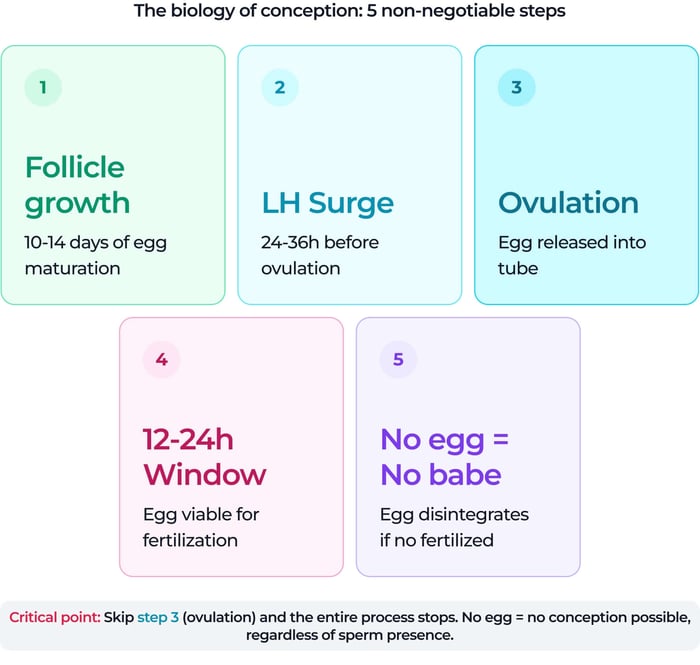
Here's what happens during ovulation:
- Follicle maturation: Over 10-14 days, a follicle in your ovary develops and matures an egg
- LH surge: Luteinizing hormone spikes 24-36 hours before ovulation, triggering the release
- Egg release: The mature egg bursts from the follicle and enters the fallopian tube
- Fertilization window opens: For the next 12-24 hours, the egg can be fertilized by sperm
- Window closes: If not fertilized, the egg disintegrates and is absorbed by the body
Without step 3 (ovulation), there is no egg. Sperm can be present in perfect conditions, but with nothing to fertilize, conception cannot happen.
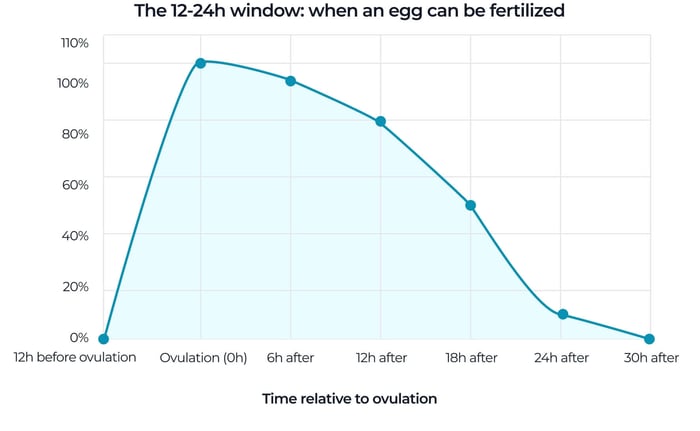
Source: Wilcox AJ, et al. (1995). "Timing of Sexual Intercourse in Relation to Ovulation." New England Journal of Medicine. DOI: 10.1056/NEJM199512073332301
Why you can still get pregnant from sex before ovulation
This is where timing gets confusing, and where many "I got pregnant when I wasn't ovulating" stories come from.
The 5-Day Sperm Survival Rule
Under optimal conditions (in fertile cervical mucus), sperm can survive up to 5 days in the female reproductive tract. This means:
- Sex on Monday -> Sperm can survive until Saturday
- If you ovulate on Friday, sperm from Monday are still viable
- You get pregnant from sex 4 days before ovulation
This creates the "fertile window": the 6-day period when pregnancy is possible, consisting of:
- 5 days before ovulation (sperm waiting for egg)
- Day of ovulation itself (sperm meets fresh egg)
Research shows the highest conception probability occurs when intercourse happens 1-2 days before ovulation, not on ovulation day.
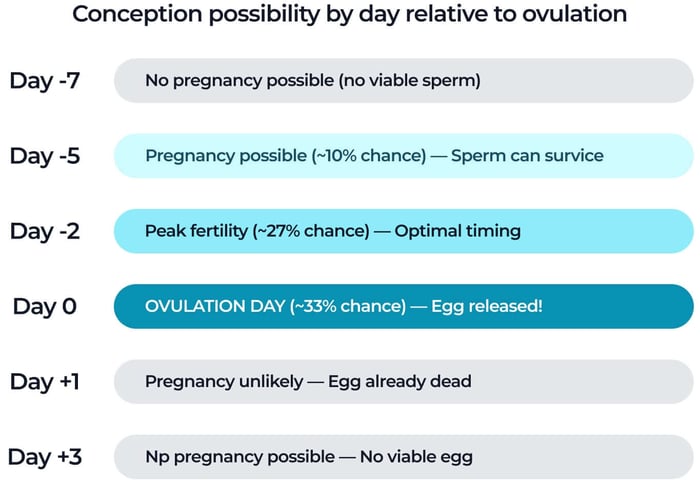
Common scenarios that seem like "pregnancy without ovulation"
Scenario 1: "I got pregnant on my period!"
The Misconception
You can get pregnant during menstruation without ovulation.
The Truth
You can get pregnant from sex during your period if you have a short cycle and early ovulation. Here's how:
- Period lasts 5-7 days (bleeding on days 1-7)
- Sex on day 6 of your period
- Sperm survive for 5 days (until day 11)
- You ovulate on day 10 (short 23-day cycle)
- Viable sperm present when egg releases -> Pregnancy
You didn't get pregnant "on your period", you got pregnant because sperm from period sex survived until ovulation.
Scenario 2: "I tracked ovulation perfectly and still got pregnant outside my window"
The Misconception
Ovulation tracking failed, so pregnancy happened without ovulation.
The Truth
Ovulation timing varies by 5+ days in 46% of women. What likely happened:
- You predicted ovulation on day 14 (based on apps or averages)
- Actual ovulation occurred on day 11 or day 17 (within normal variation)
- Intercourse aligned with actual ovulation, not predicted ovulation
Scenario 3: "I got pregnant while breastfeeding/on birth control - I wasn't ovulating!"
The Misconception
Breastfeeding or birth control completely prevents ovulation, so pregnancy is impossible.
The Truth
Both methods suppress ovulation but don't eliminate it 100%:
- Breastfeeding (LAM): 98% effective if exclusively breastfeeding, but ovulation can return unpredictably before your first post-birth period
- Birth control pills: 91% effective with typical use (human error); breakthrough ovulation can occur if pills are missed
- The key: You did ovulate (unexpectedly), which is why pregnancy occurred
Know Exactly When You're Ovulating
Stop guessing. Pregmate ovulation tests detect your LH surge with 99% accuracy, giving you a 24-36 hour advance warning before ovulation.
How to confirm you're actually ovulating
Since ovulation is invisible, how do you know it's happening? Here are the most reliable methods:
| Method | What It Detects | Accuracy | Best For |
|---|---|---|---|
| Ovulation Predictor Kits (OPKs) | LH surge 24-36h before ovulation | 94-99% | Predicting ovulation in advance |
| Basal Body Temperature (BBT) | 0.5-1°F rise after ovulation | High (confirms ovulation occurred) | Confirming ovulation happened |
| Cervical Mucus Tracking | "Egg white" mucus before ovulation | Moderate (requires practice) | Free method, early warning |
| Progesterone Blood Test | Progesterone > 3 ng/mL confirms ovulation | Very high (medical-grade) | Diagnosing anovulation |
| Transvaginal Ultrasound | Follicle rupture visualization | Gold standard | Fertility treatment monitoring |
Best approach: Use OPKs to predict ovulation + BBT to confirm it happened. This dual method gives you both advance warning and retrospective confirmation.
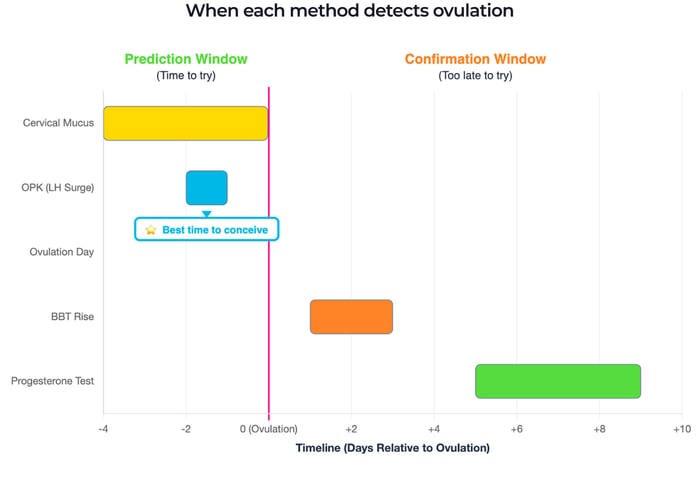
Source: Mu Q, Fehring RJ. (2023). "Hormonal Fertility Monitoring Systems for Ovulation Detection." Medicina (Kaunas). DOI: 10.3390/medicina59020400
What if you're actually not ovulating? (Anovulation)
Anovulation is the medical term for cycles without ovulation. It's more common than you think:
- Affects 30% of infertility cases
- Can occur occasionally in healthy women (1-2 anovulatory cycles per year is normal)
- More frequent in certain conditions (PCOS, thyroid disorders, extreme stress)
Signs you may not be ovulating:
- Irregular or absent periods: Cycles shorter than 21 days or longer than 35 days
- No LH surge detected: Ovulation tests never turn positive after multiple cycles of testing
- No BBT shift: Your temperature chart shows no clear rise (stays flat throughout cycle)
- Lack of fertile cervical mucus: Never observe "egg white" consistency mucus mid-cycle
Common causes of anovulation:
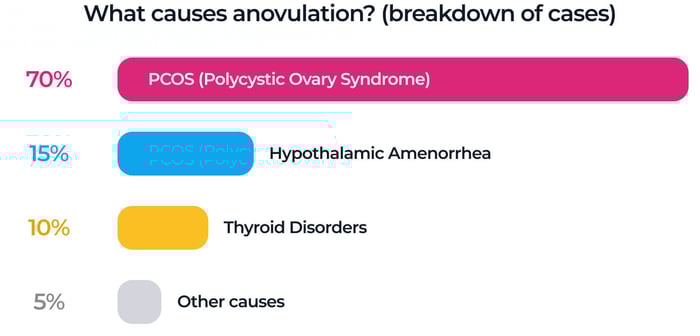
Source: American College of Obstetricians and Gynecologists (ACOG). (2019). "Anovulation and Infertility." www.acog.org
| Condition | How It Affects Ovulation |
|---|---|
| PCOS (Polycystic Ovary Syndrome) | Hormonal imbalance prevents follicles from maturing; causes 70% of anovulatory infertility |
| Hypothalamic Amenorrhea | Stress, low body weight, or excessive exercise suppresses GnRH production |
| Thyroid Disorders | Both hyperthyroidism and hypothyroidism disrupt ovulation |
| Hyperprolactinemia | Elevated prolactin (from medications or pituitary tumors) inhibits ovulation |
| Premature Ovarian Insufficiency (POI) | Ovaries stop functioning normally before age 40 |
When to see a doctor: If you've been trying to conceive for 12 months without success (or 6 months if you're over 35), or if you suspect anovulation based on tracking, consult a reproductive endocrinologist.
The bottom line: No ovulation = No pregnancy
Let's be crystal clear on the science:
The Non-Negotiable Biology of Conception
- Ovulation must occur for an egg to be present
- The egg lives only 12-24 hours after ovulation
- Sperm can survive up to 5 days in fertile mucus
- Fertilization can only happen when viable sperm meets viable egg
- Therefore: No ovulation = No egg = No fertilization = No pregnancy
Every case of "I got pregnant when I wasn't ovulating" actually means:
- "I got pregnant from sex before ovulation (sperm waited for the egg)"
- "I miscalculated when I ovulated"
- "I ovulated unexpectedly (despite breastfeeding/birth control/etc.)"
Pregnancy without ovulation is biologically impossible. But pregnancy from intercourse before ovulation is not only possible, it's the most likely scenario.
Track Your Ovulation with Confidence
Download the free Pregmate app to log ovulation tests, track your cycle, and identify your true fertile window with precision.
Frequently asked questions
Q: Can you get pregnant even when you're not ovulating?
A: No. Ovulation is required for pregnancy because it provides the egg. However, you can get pregnant from intercourse before ovulation because sperm can survive up to 5 days waiting for the egg to be released.
Q: Can you still get pregnant when you're not ovulating?
A: If you're truly not ovulating (anovulation), pregnancy is impossible. But if you mean "Can I get pregnant from sex on a day I'm not ovulating?" yes, if ovulation occurs within 5 days after intercourse.
Q: How long after sex do you need to ovulate to get pregnant?
A: Sperm can survive up to 5 days in optimal conditions. This means ovulation can occur up to 5 days after intercourse and still result in pregnancy. The highest conception probability is when ovulation occurs 1-2 days after sex.
Q: Can you get pregnant when you're not ovulating or fertile?
A: No. The "fertile window" and ovulation are directly connected, you're fertile because ovulation is approaching or has just occurred. Outside this window (when ovulation isn't happening and won't happen soon), pregnancy is impossible.
Q: What are the chances of getting pregnant if you're not ovulating?
A: Zero. Without ovulation, there is no egg to fertilize, making conception biologically impossible regardless of intercourse timing or sperm quality.
Q: Can I get pregnant 2 weeks after ovulation?
A: No. The egg only lives 12-24 hours after ovulation. Two weeks later, you'd be approaching or experiencing your next period. If you don't get pregnant in a given cycle, you must wait for the next ovulation.
Understanding your fertility = Better conception timing
The answer to "Can you get pregnant when you're not ovulating?" is an unequivocal no, but understanding why clarifies how conception actually works.
The key insights:
- Ovulation is non-negotiable for pregnancy (no egg = no baby)
- Sperm longevity creates a 6-day fertile window around ovulation
- Conception is most likely from sex 1-2 days before ovulation, not on ovulation day
- Apparent "pregnancy without ovulation" cases are always misunderstood timing
The practical takeaway: Focus on detecting ovulation accurately (via OPKs, BBT, or cervical mucus) rather than relying on calendar predictions. When you know your true ovulation timing, you maximize your chances of conception by having intercourse in the critical 2-3 days before the egg is released.
Medical disclaimer
This article is for informational purposes only and does not constitute medical advice. The information about ovulation and conception timing should not replace consultation with a healthcare provider. If you have been trying to conceive for 12 months without success (or 6 months if over age 35), or if you suspect anovulation or other fertility issues, please consult a reproductive endocrinologist or OB-GYN. Individual fertility varies, and personalized medical guidance is essential for addressing specific concerns.
Key Research & References
All facts and statistics in this article are linked directly to their sources. Below is the complete bibliography:
- Bigelow, J.L., Dunson, D.B., Stanford, J.B., Ecochard, R., Gnoth, C., & Colombo, B. (2004). "Mucus observations in the fertile window: a better predictor of conception than timing of intercourse." Human Reproduction, 19(4), 889-892. https://doi.org/10.1093/humrep/deh173
- Wilcox, A.J., Weinberg, C.R., & Baird, D.D. (1995). "Timing of Sexual Intercourse in Relation to Ovulation - Effects on the Probability of Conception, Survival of the Pregnancy, and Sex of the Baby." New England Journal of Medicine, 333(23), 1517-1521. https://doi.org/10.1056/NEJM199512073332301
- Mu, Q., & Fehring, R.J. (2023). "A Comparison of Two Hormonal Fertility Monitoring Systems for Ovulation Detection: A Pilot Study." Medicina (Kaunas), 59(2), 400. https://doi.org/10.3390/medicina59020400
- American Society for Reproductive Medicine (ASRM). (2022). "Optimizing Natural Fertility: A Committee Opinion." Fertility and Sterility, 117(3), 533-546. https://www.asrm.org/
- Colombo, B., & Masarotto, G. (2000). "Daily fecundability: first results from a new data base." Demographic Research, 3, Article 5. https://www.demographic-research.org/volumes/vol3/5/
- Labbok, M.H., Hight-Laukaran, V., Peterson, A.E., Fletcher, V., von Hertzen, H., & Van Look, P.F. (1997). "Multicenter study of the Lactational Amenorrhea Method (LAM): I. Efficacy, duration, and implications for clinical application." Contraception, 55(6), 327-336. https://doi.org/10.1016/s0010-7824(97)00040-1
- American College of Obstetricians and Gynecologists (ACOG). (2019). "Anovulation." ACOG Practice Bulletin No. 194. Obstetrics & Gynecology, 133(1), e71-e109. https://www.acog.org/