
If you are in the two week wait, this guide covers what is happening each day, your real odds of a positive, and how to count DPO so your timing holds up.
What DPO means
DPO stands for days past ovulation. 1 DPO is the day after you ovulate, and the count runs until your period starts or you get a positive test. The roughly two weeks between ovulation and your expected period is often called the two week wait.
Counting from ovulation matters because cycles differ. On cycle day 25, someone who ovulated on day 14 is at 11 DPO, while someone who ovulated on day 18 is only at 7 DPO. The phase after ovulation also varies: in one UK cohort it averaged 13.2 days, with a spread of about two days either way. Unless your ovulation was confirmed, your DPO count is an estimate.
How to estimate your ovulation day
A positive ovulation test detects the LH surge, and ovulation typically follows about a day after the surge, though timing varies. A positive test predicts ovulation rather than confirming it. Many people count the day after their first positive test as an approximate ovulation day, which works for planning as long as you treat the result as an estimate.
Estimates based on cycle length alone are less dependable, since apps that predict ovulation from past cycles can be far off for many users.
Why a test can't work right after ovulation
Home pregnancy tests detect hCG in urine. After the embryo attaches to the uterine lining, early placental tissue starts making hCG, and it takes time for urine levels to rise above a test's detection threshold. In a landmark NIH study that tracked daily urine samples, hCG first appeared 6 to 12 days after ovulation in pregnancies that continued, and 84% implanted on day 8, 9, or 10.
In early pregnancy, hCG rises quickly, roughly doubling about every two days, though the pace differs between pregnancies. That is why retesting 48 hours after an early negative makes sense. It also means line darkness on a home test is not a reliable way to judge how a pregnancy is developing.
Home tests like Pregmate detect hCG from 25 mIU/mL, and it usually takes a few days after implantation to reach that level.
From ovulation to a positive pregnancy test

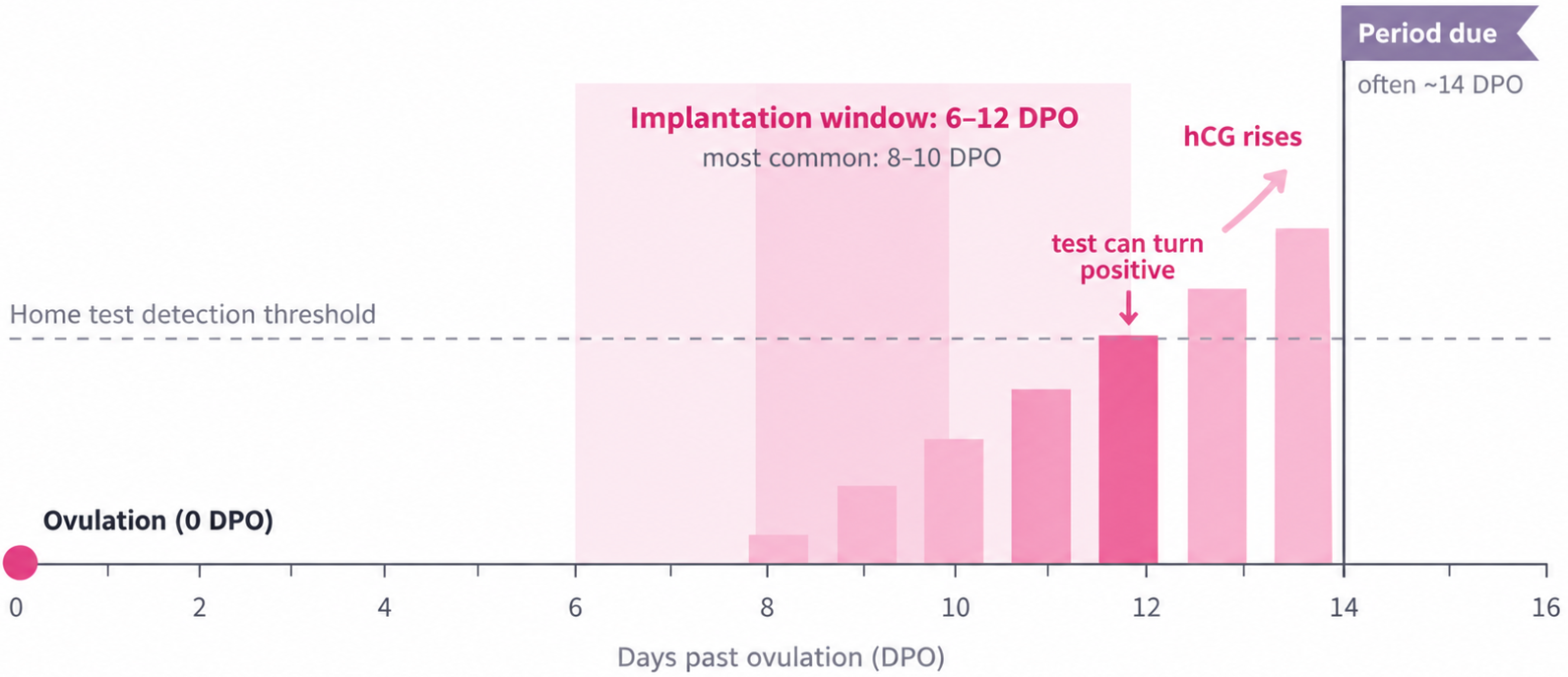
Your chance of a positive pregnancy test by DPO and expected period
The newest real-world numbers come from PRESTO, a North American cohort of people trying to conceive. Researchers analyzed 19,908 home pregnancy tests from 5,979 participants who became pregnant, all using tests with a 25 mIU/mL threshold. The study counted days from the expected period, not from confirmed ovulation. The DPO column below is a rough conversion that assumes ovulation about 14 days before your period, so if you ovulated later or your luteal phase is shorter or longer, your timeline will shift.
| Day of test | Approx. DPO (if you ovulated ~14 days before your period) | Chance of a positive if pregnant | What it means |
|---|---|---|---|
| 4+ days before period | 10 DPO or earlier | ~54% | about half still test negative |
| 3 days before period | 11 DPO | ~79% | roughly 1 in 5 false negatives |
| 2 days before period | 12 DPO | ~87% | most pregnancies now show |
| 1 day before period | 13 DPO | ~92% | a negative is more informative, not final |
| Day period is due | 14 DPO | ~95% | reliable for most people |
| 1 day after | 15 DPO | ~97% | very few missed |
| 2 days after | 16 DPO | ~98% | very few missed |
| 3 days after | 17 DPO | ~99% | nearly all detected |
| 4+ days after | 18 DPO or later | ~99.6% | nearly all detected |
Participants with regular cycles, tests with a 25 mIU/mL threshold. Values are the chance of a positive result among people who were pregnant, not the chance that you are pregnant. DPO equivalents are approximate and cannot confirm when you ovulated. Source: Sundermann et al., Fertility and Sterility, 2026.
Chance of a positive pregnancy test around your expected period

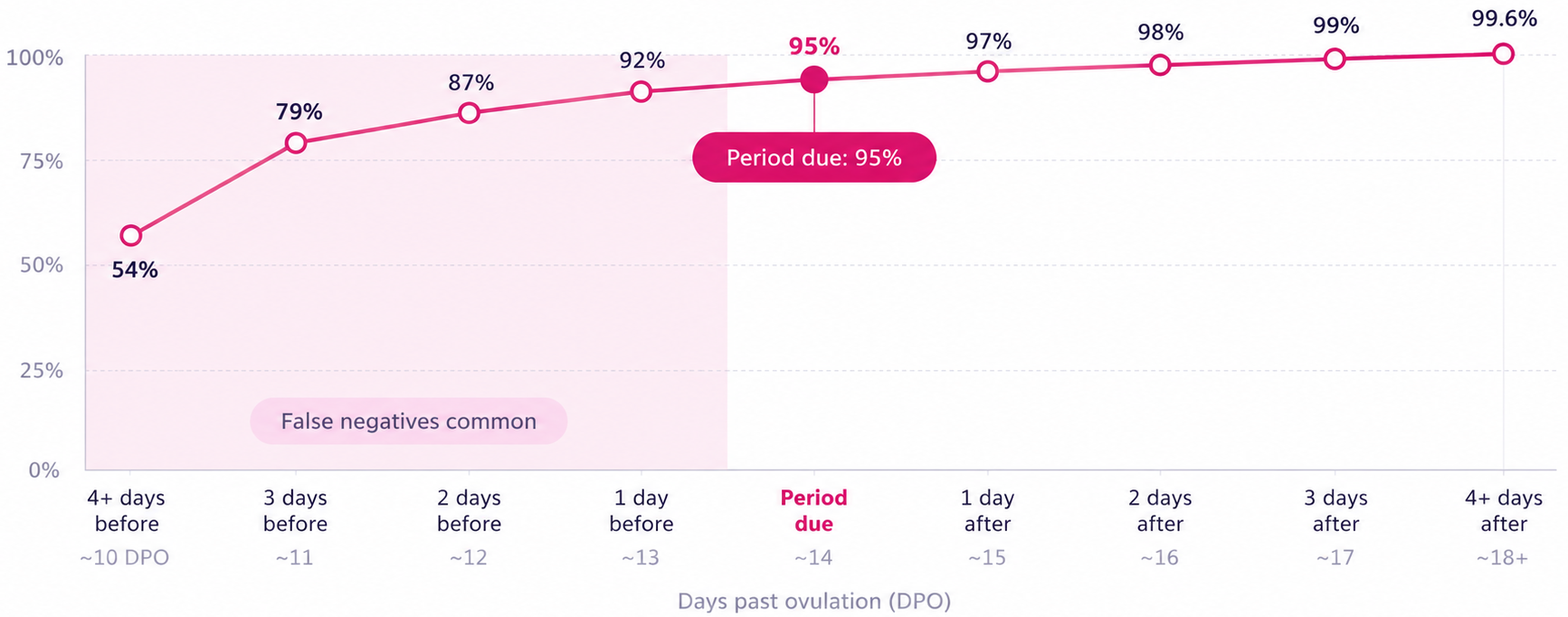
Two findings stand out. First, early testing produces many false negatives: 46% of pregnant people with regular cycles who tested four or more days before their expected period got a negative result. Second, cycle length shifts the odds. Participants with shorter cycles were less likely to test positive on any given day, and those with irregular cycles had lower sensitivity on every testing day.
Real-world use also runs a little below lab figures. Across the whole cohort, including irregular cycles, 94% tested positive on the day of the expected period, while accuracy numbers on test packaging come from controlled lab conditions.
Test when it counts
Pregmate pregnancy test strips detect hCG from 25 mIU/mL, the same threshold as the tests in this study. With a multi-strip pack, retesting 48 hours after an early negative doesn't mean another trip to the store.
DPO pregnancy test day by day
7 DPO pregnancy test
At 7 DPO, implantation may not have happened yet. In pregnancies that continued, hCG was most often first detected 8 to 10 days after ovulation. A negative test at 7 DPO cannot rule out pregnancy.
8 DPO pregnancy test
At 8 DPO, a positive result is possible but uncommon. Even when implantation happens early, urine hCG may not yet have reached the detection threshold of a home test, so most pregnancies still test negative today.
9 DPO pregnancy test
9 DPO is close to the average implantation day in the Wilcox study, so many pregnancies are only starting to make hCG and still test negative. If you test at 9 DPO, plan on testing again.
10 DPO pregnancy test
10 DPO is the most searched testing day and often the most frustrating one. In PRESTO, among participants with regular cycles who tested four or more days before their expected period, about 54% got a positive, so nearly half still tested negative despite being pregnant. For someone who ovulated about 14 days before their period, that timing is roughly 10 DPO. If your test is negative, wait 48 hours and use first morning urine next time.
11 DPO pregnancy test
The odds climb quickly. Three days before the expected period, roughly 11 DPO, about 4 in 5 pregnant participants tested positive, which means about 1 in 5 still saw a negative. Faint lines are common now, so read the result within the time on the instructions.
12 and 13 DPO pregnancy test
Two days before the expected period, roughly 12 DPO, about 87% of pregnant participants with regular cycles tested positive, and about 92% one day before. A negative is more informative at this point, but it can't fully rule out pregnancy if you ovulated later than you think.
14 DPO and later
On the day your period is due, about 95% of pregnant people with regular cycles test positive, and by four days later nearly all do. If you get a positive, contact an OB-GYN, midwife, or other healthcare professional to talk about next steps and prenatal care. If your test is negative and your period still hasn't started, test again in a few days, and check in with your healthcare professional if results stay negative.
In my practice, the early negative is the part of the two week wait patients find hardest. A test at 9 or 10 DPO is looking for a hormone that may not be there yet. Waiting until your period is due spares you days of worry and a lot of tests.
Is 10 DPO too early to test?
You can test at 10 DPO, but only a positive result tells you something. A negative is expected for many pregnancies at that point, because hCG may still be below what a home test can read. For the most reliable single test, wait until the day your period is due.
How to get an accurate result when testing early
- Use first morning urine. It is the most concentrated sample of the day. If you test later, try to wait about three hours since you last urinated.
- Skip the extra water. Drinking a lot right before testing dilutes hCG.
- Follow your test's instructions. Read the result within the stated window, since lines that appear later can be misleading.
- Retest if your period doesn't start. After an early negative, test again in 48 hours to a few days.
- Treat DPO as an estimate. Count from your LH surge rather than a calendar guess, and remember the exact ovulation day can't be confirmed at home.
Know your likely DPO
Your DPO count is only as good as your ovulation estimate. Pregmate ovulation test strips catch your LH surge, and the Pregmate app scans each strip and reads the T/C ratio for you, so you can pinpoint your surge and estimate when you likely ovulated. The app is free to download, tracks your cycle and fertile window, and stays with you into pregnancy.
What the two week wait can feel like
Progesterone rises after ovulation in every cycle, pregnant or not. That is why breast tenderness, bloating, fatigue, and mild cramping show up during the two week wait whether or not you conceived, and symptoms before a missed period can't tell you much.
Some people notice light spotting in early pregnancy, but spotting alone can't confirm implantation or pregnancy. It is also easy to mistake for an early period, which can throw off when you expect your period and when you test. Talk to a healthcare professional about heavy bleeding or pain that worries you.
It is normal for these days to feel long. Choosing your testing day in advance, and sticking to it, is one of the simplest ways to protect your peace of mind.
The bottom line
Implantation is most often first detected 8 to 10 days after ovulation, but timing varies, so a test can still be negative at 9 or 10 DPO. For the most reliable result, test on or after the day your period is due, often around 14 DPO if your ovulation estimate is accurate. After an early negative, retest in 48 hours to a few days if your period hasn't started, and seek urgent care for severe pain, shoulder pain, fainting, or heavy bleeding.
Frequently asked questions
How many DPO can you take a pregnancy test?
You can test from about 10 DPO, but a negative that early isn't reliable. For the most dependable result, test on or after the day your period is due, often around 14 DPO. In the 2026 PRESTO study, 95% of pregnant people with regular cycles tested positive on that day.
Can you get a positive pregnancy test at 8 DPO?
Yes, it's possible, but a negative at 8 DPO is much more common and doesn't rule out pregnancy. Implantation is most often first detected 8 to 10 days after ovulation, and urine hCG needs more time to reach a test's threshold.
Why is my pregnancy test negative at 12 DPO?
A negative at 12 DPO can happen even if you're pregnant. You may have ovulated or implanted later than estimated, or your urine may be diluted. Test again in 48 hours to a few days if your period hasn't started, and contact a healthcare professional if tests stay negative and your period is still absent.
What does DPO mean?
DPO means days past ovulation. 1 DPO is the day after ovulation, and people trying to conceive use DPO to estimate when a pregnancy test is likely to work.
Sources
- Sundermann AC, Jasper EA, Buckley RJ, Rothman KJ, Wise LA. Home Pregnancy Test Sensitivity by Test Timing and Cycle Length With Real-World Use Among Pregnancy Planners Who Conceived. Fertility and Sterility, 2026. sciencedirect.com
- Wilcox AJ, Baird DD, Weinberg CR. Time of Implantation of the Conceptus and Loss of Pregnancy. New England Journal of Medicine, 1999;340(23):1796-1799. pubmed.ncbi.nlm.nih.gov
- Johnson SR, Miro F, Barrett S, Ellis JE. Levels of Urinary Human Chorionic Gonadotrophin (hCG) Following Conception and Variability of Menstrual Cycle Length in a Cohort of Women Attempting to Conceive. Current Medical Research and Opinion, 2009;25(3):741-748. pubmed.ncbi.nlm.nih.gov
- Marriott L, Zinaman M, Abrams KR, Crowther MJ, Johnson S. Analysis of Urinary Human Chorionic Gonadotrophin Concentrations in Normal and Failing Pregnancies. Annals of Clinical Biochemistry, 2017. journals.sagepub.com
- Soumpasis I, Grace B, Johnson S. Real-Life Insights on Menstrual Cycles and Ovulation Using Big Data. Human Reproduction Open, 2020. pmc.ncbi.nlm.nih.gov
- U.S. Food and Drug Administration. Guidance for Over-the-Counter (OTC) Human Chorionic Gonadotropin (hCG) 510(k)s. fda.gov
- Mayo Clinic. Home Pregnancy Tests: Can You Trust the Results? mayoclinic.org
- Cleveland Clinic. Pregnancy Tests: When to Take, Types and Accuracy. 2026. clevelandclinic.org
- American College of Obstetricians and Gynecologists. Ectopic Pregnancy. acog.org
- Pregmate. How Early Can Pregmate Detect Pregnancy? 2026. pregmate.com