
Yoga comes up in almost every conversation about trying to conceive, usually carrying more promise than it can deliver. Here is the honest version. Yoga is not a fertility treatment. It will not unblock a fallopian tube, correct ovulation, or replace medical care, and it does not detox your ovaries or redirect blood to your uterus, because the body does not work that way.
What it can do is worth taking seriously. Trying to conceive wears on most people, and the research on yoga is largely about easing that strain, with a smaller but real signal that regular practice helps women with PCOS. That is reason enough to make room for it. The eight poses further down are chosen for those benefits, so you always know what you are practicing and why.
What yoga actually does for fertility
The best evidence for yoga here has little to do with your ovaries and a lot to do with stress. Trying to conceive, and fertility treatment in particular, raises anxiety for most people. A 2022 systematic review of yoga in infertile individuals found it was associated with lower stress and anxiety, and the authors suggest it as an adjunct alongside fertility treatment. That part is consistent across the literature.
Whether it changes outcomes, not just how you feel, is a separate and much weaker question. The study most often cited here is an older, small trial of 143 women in a ten-session mind-body program that combined yoga, meditation, and cognitive techniques. Its primary randomized comparison, the first IVF cycle, found no difference in pregnancy rates. A higher rate turned up only in a later cycle, among women who had not yet conceived, which is a post-randomization subgroup and a much weaker kind of evidence. A 2024 trial of the same program reported similar gains in wellbeing but did not establish a clean effect on pregnancy rates. The honest summary: yoga is well supported for how you feel, and unproven for whether you conceive.
| Claim | What the research shows |
|---|---|
| Lowers stress and anxiety during TTC and IVF | Supported. Multiple controlled trials and reviews. |
| Helps people cope with and stay in fertility treatment | Supported. |
| Improves cycle regularity and hormones in PCOS | Supported in controlled trials (see the PCOS section). |
| Directly raises your odds of conceiving | Not shown. The most-cited trial found no difference in its main randomized comparison. |
| “Detoxes,” reroutes blood to the ovaries, raises sperm count | Not supported. No credible evidence. |
Sources: Demir Yildirim & Gungor Satilmis, Holist Nurs Pract 2022; Domar et al., Fertil Steril 2011; Szigeti et al., Hum Reprod 2024. Full citations below.
Build the calm on the mat, keep the clarity off it
The Pregmate app tracks your cycle, fertile window, and symptoms in one place, so the steadiness you practice does not get undone by second-guessing.
What yoga can’t do, and the myths to drop
A few claims about fertility yoga get repeated so often they start to sound true. They are not, and clearing them up saves you time and worry.
It does not stimulate or “activate” your ovaries or uterus. Holding a pose does not send targeted blood flow to a specific organ in any way that changes fertility.
Inversions do not help you conceive. Headstands, shoulder stands, or lying with hips up after sex have no evidence behind them. Sperm reach the cervix within minutes, regardless of what your legs are doing.
Rapid breathing does not “purify” anything. Kapalbhati is a fine energizing breath. It does not cleanse reproductive cells or balance hormones on contact.
It is not a substitute for evaluation. If you are under 35 and have been trying for 12 months, or 35 and older and trying for 6, see a doctor. If you already know something is off, such as blocked tubes, endometriosis, or very irregular cycles, don’t wait. Yoga is support, not a workaround.
8 poses worth your time
These eight are chosen to do the one thing the evidence supports: settle your nervous system and release the pelvic and lower-back tension that stress tends to park in the body. Go gently. Nothing here should hurt, and none of it needs to be advanced. Props, a cushion, a folded blanket, or a wall, make every one of these better, not weaker.
| Pose | What it actually helps with | Hold |
|---|---|---|
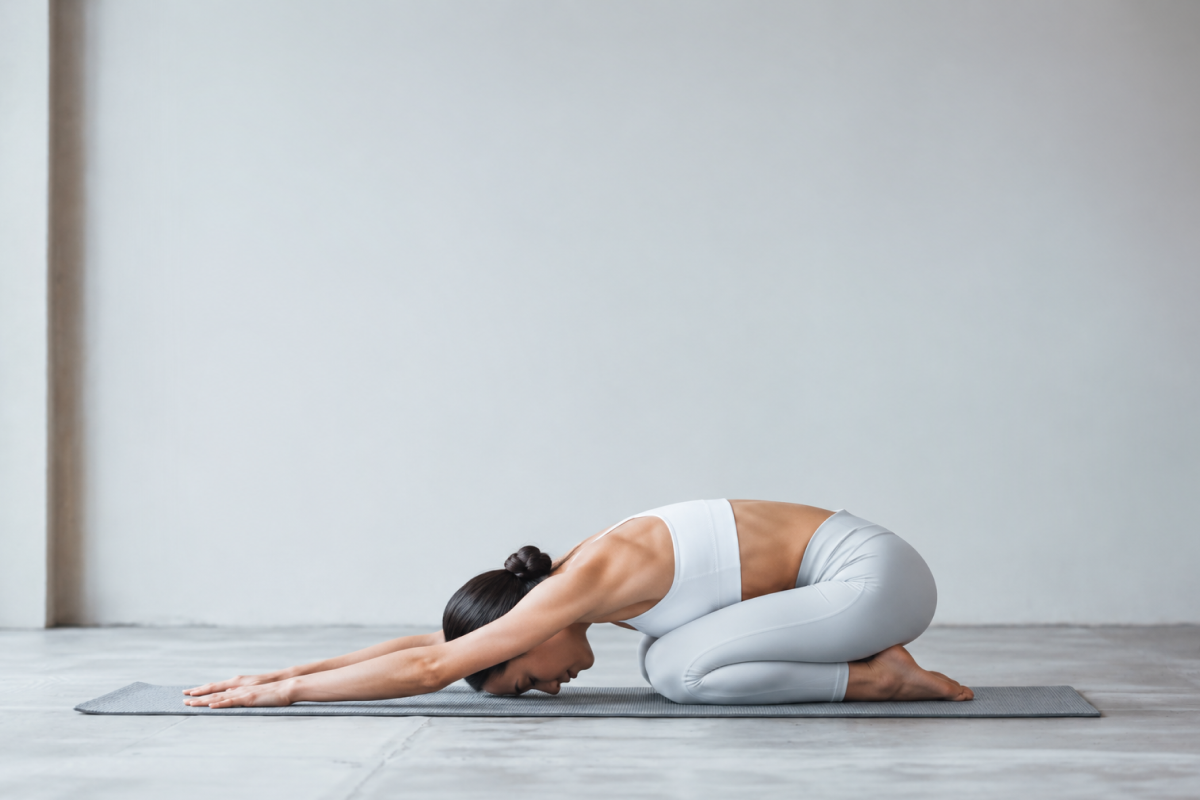
| Child’s pose | Calms the nervous system, releases lower back and hips | 1 to 3 min |
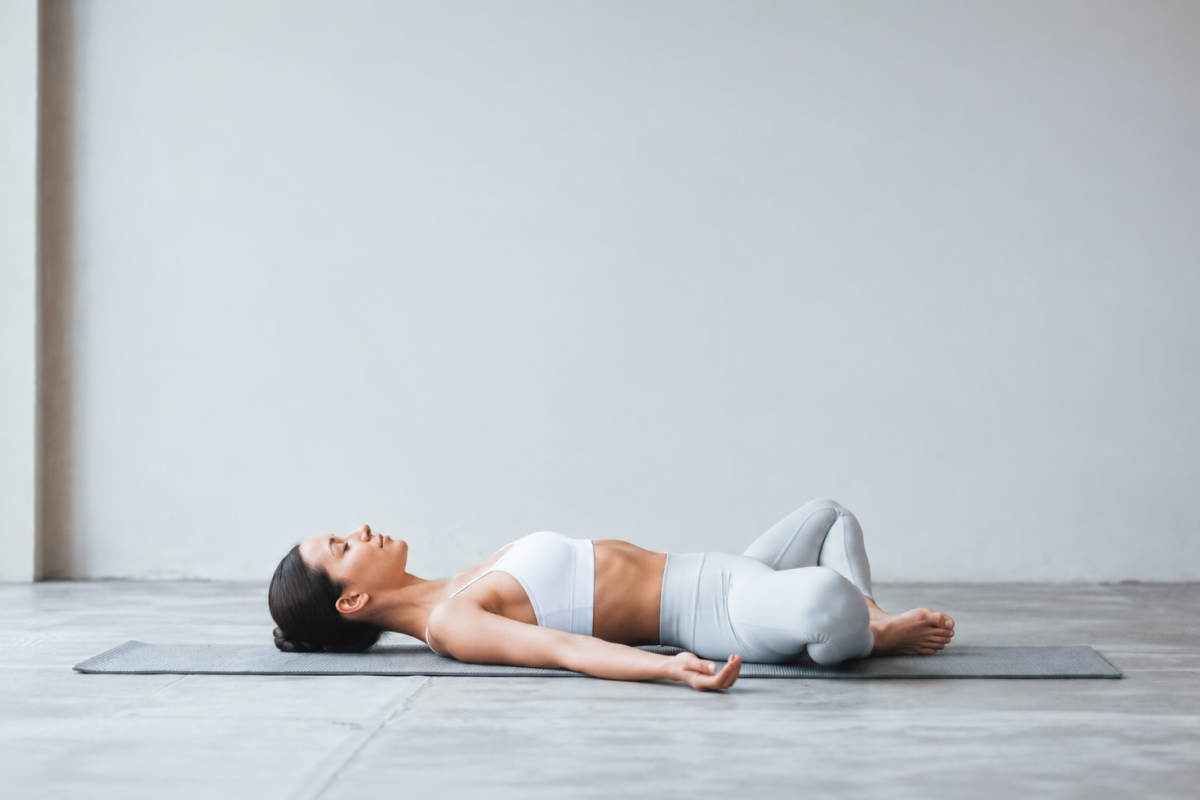
| Reclining bound angle | Deep rest, gentle hip opening, no effort | 3 to 5 min |
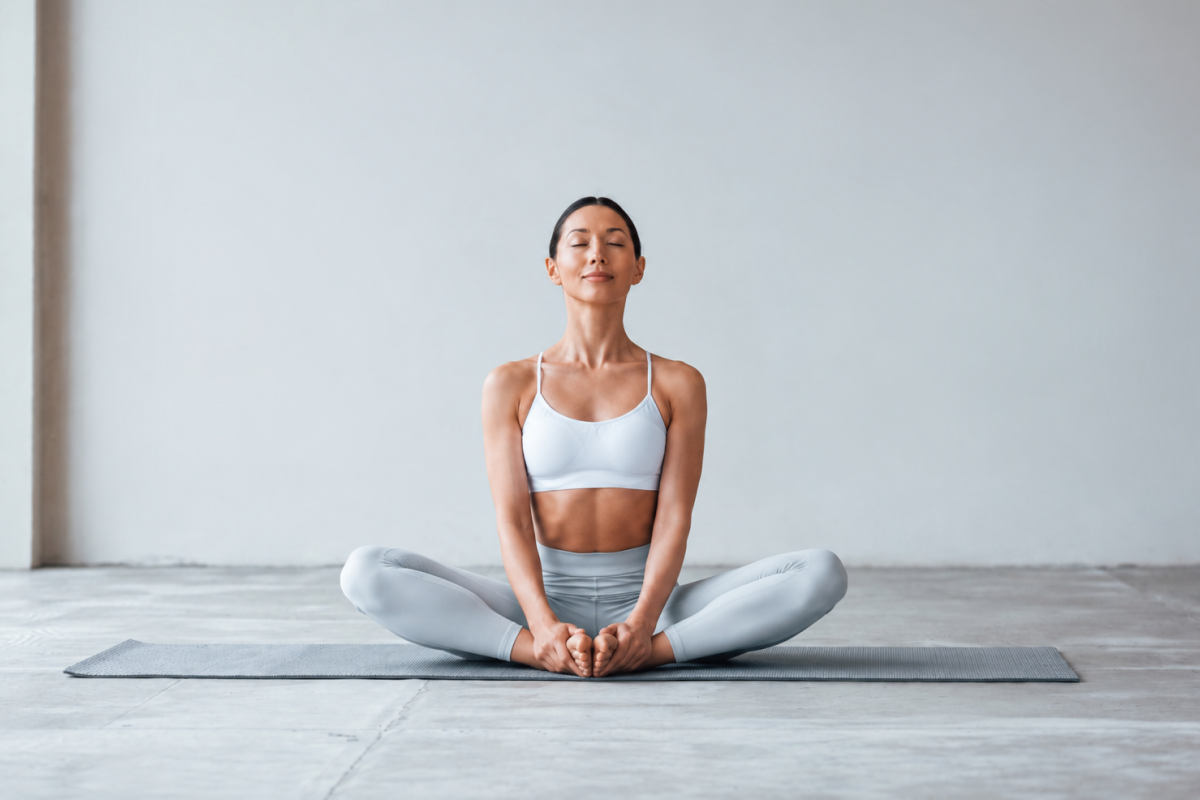
| Bound angle (butterfly) | Hip and inner-thigh release | 1 to 2 min |
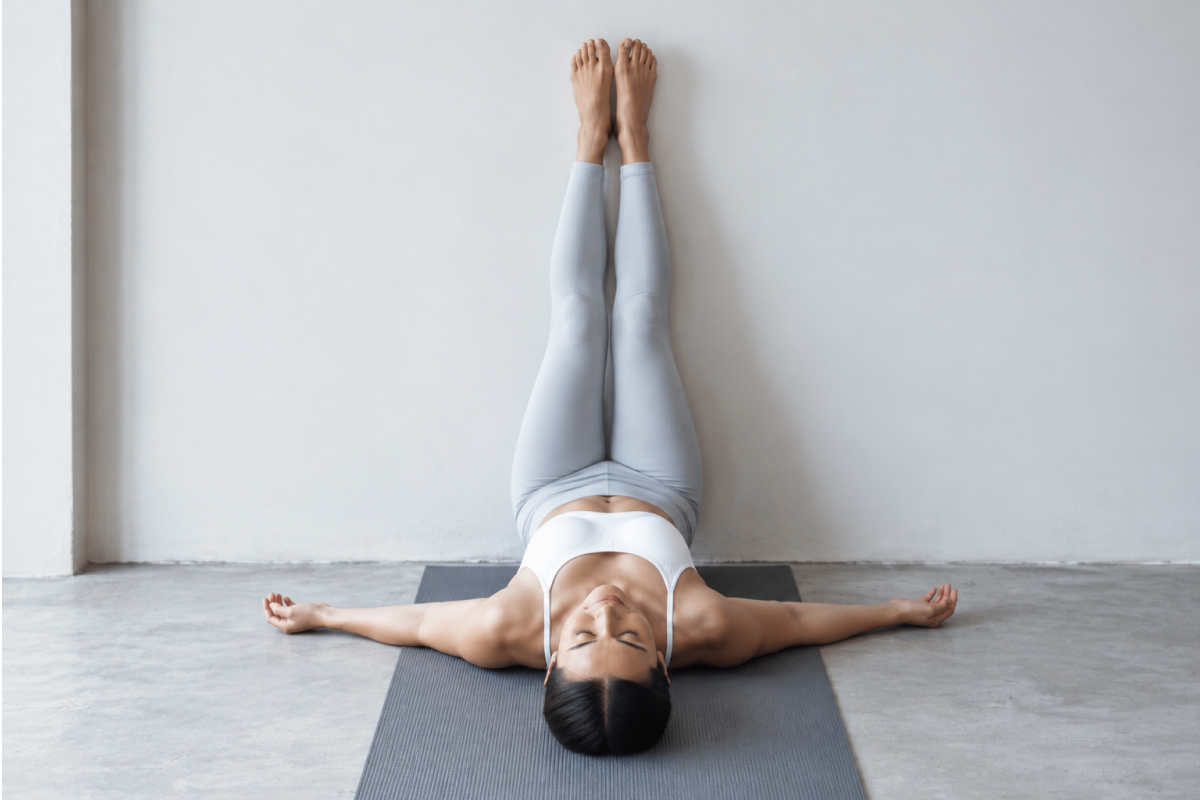
| Legs up the wall | Eases tired legs and lower back, downshifts stress | 5 to 10 min |
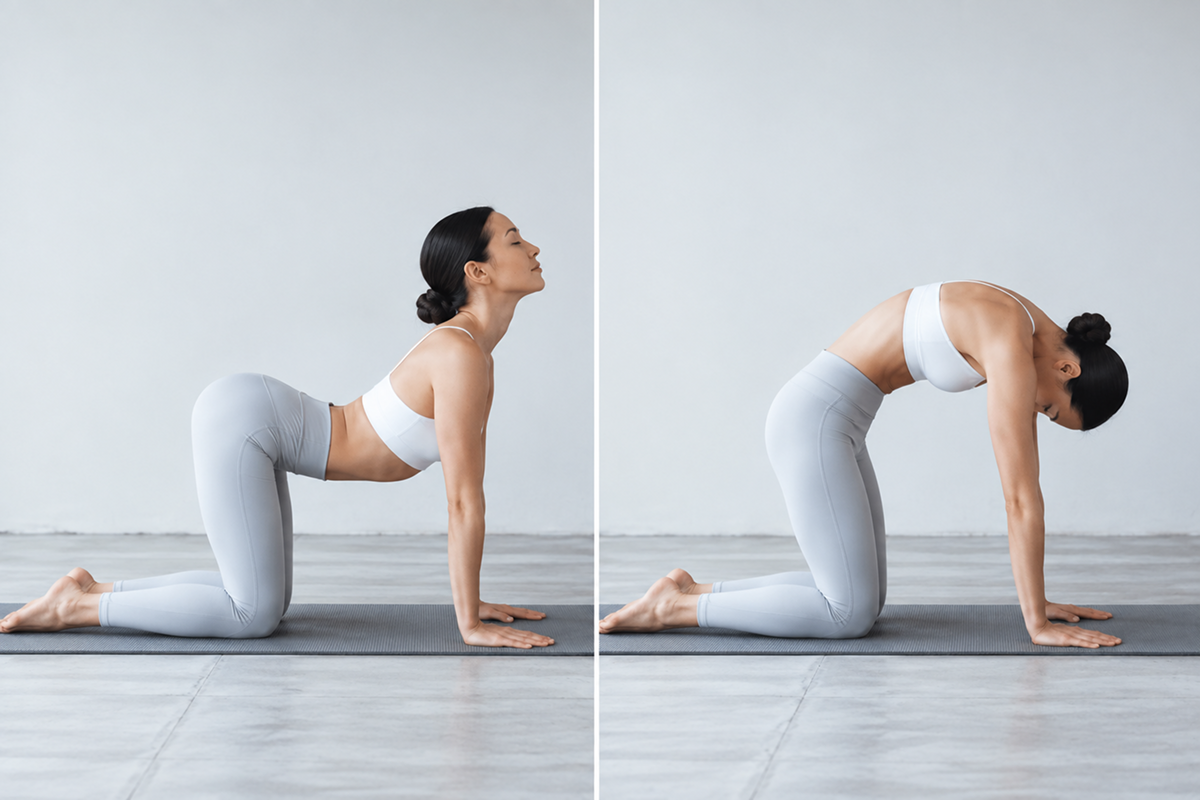
| Cat-cow | Mobilizes the spine, unloads lower-back tension | 8 to 10 breaths |
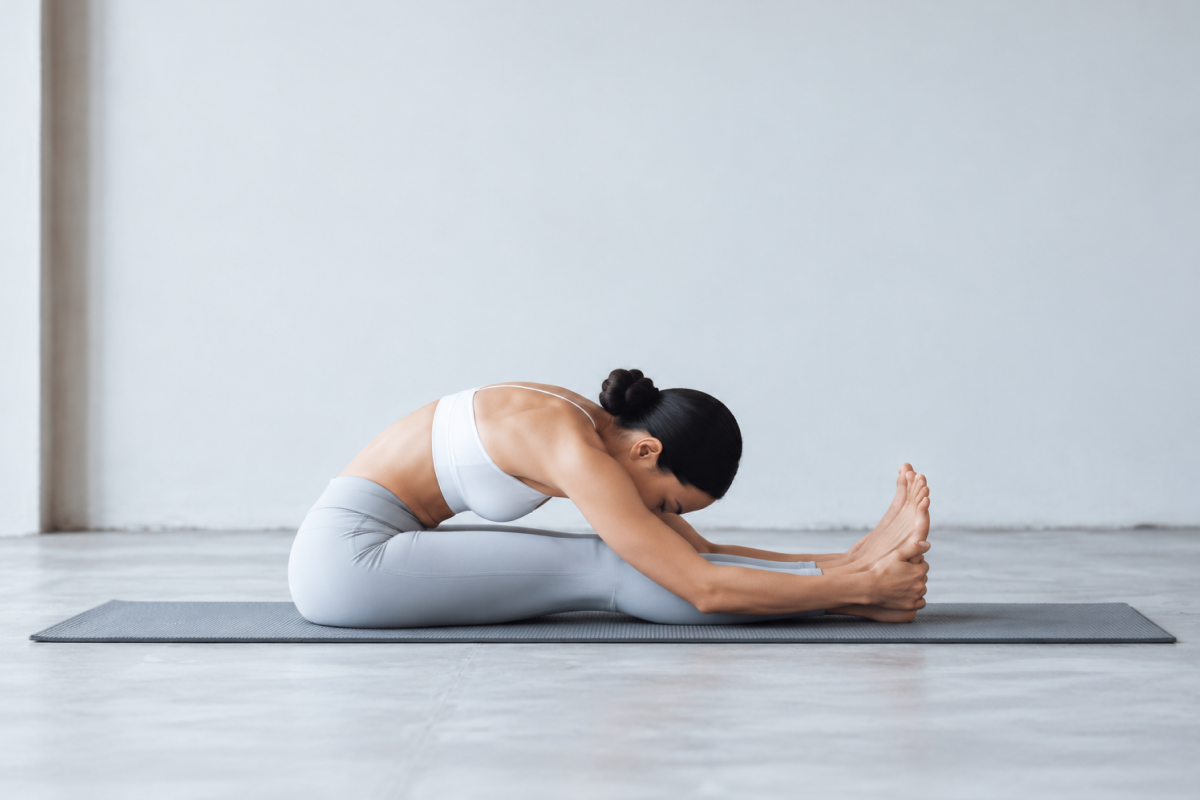
| Seated forward fold | Quiet stretch for the back body, inward focus | 1 to 2 min |
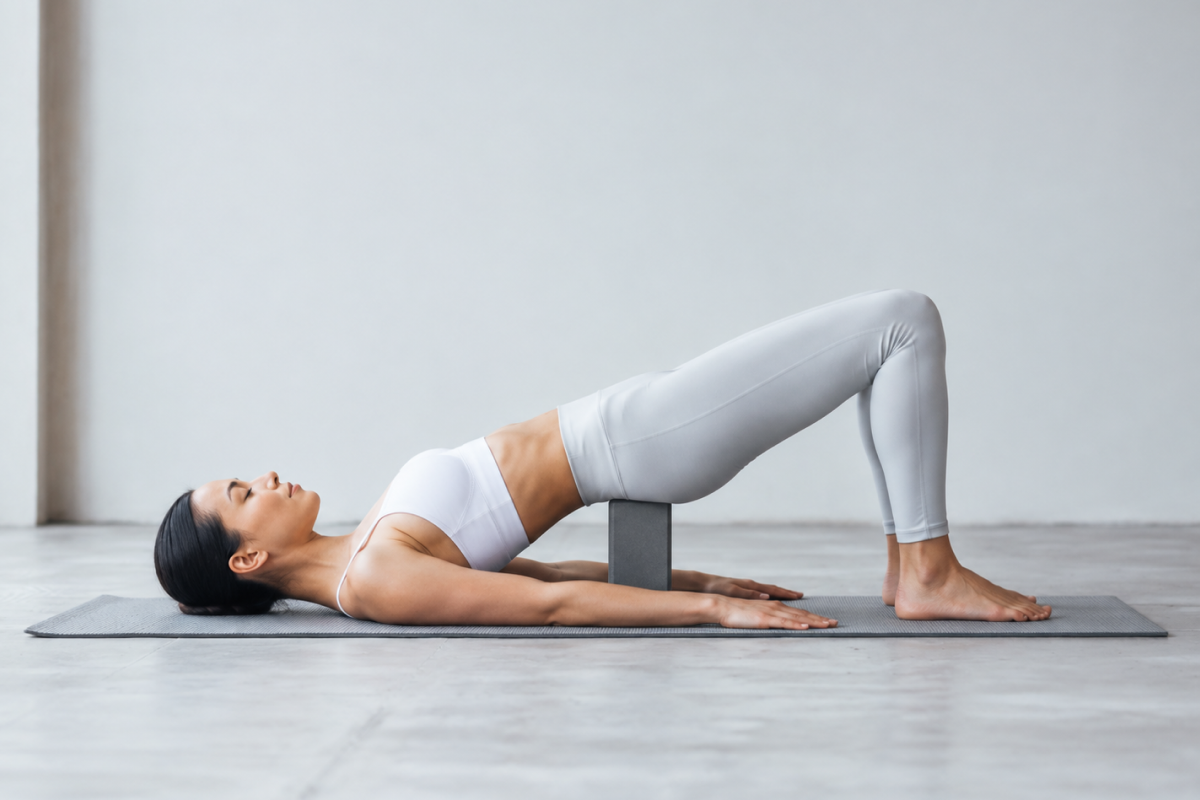
| Supported bridge | Mild chest opener, relieves lower-back tightness | 1 to 2 min |
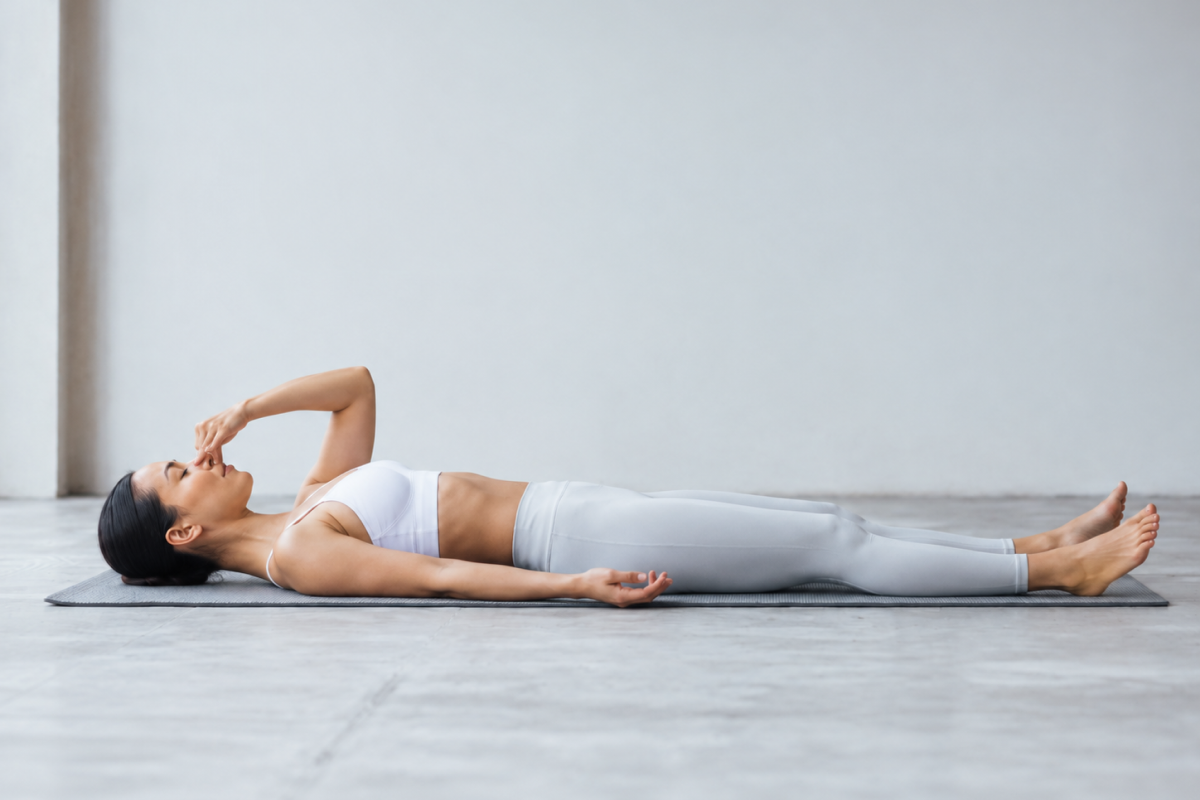
| Corpse pose + breathing | The most evidence-backed part: slow breath lowers the stress response | 5 min |
A short, gentle sequence in this order works well as a wind-down, three or so times a week.
1. Child’s pose (Balasana)
Kneel, sit your hips back toward your heels, and fold your torso forward with your forehead down. It quiets the nervous system and releases the lower back and hips. A good place to start and a good place to return to when a session feels like too much.
2. Reclining bound angle (Supta Baddha Konasana)
Lie back, bring the soles of your feet together, and let your knees fall open, ideally with a bolster under your spine and a cushion under each knee. This is the most restorative pose on the list. The hips open on their own, without you pushing anything.
3. Bound angle, or butterfly (Baddha Konasana)
The seated version. Sit tall, soles together, knees dropping toward the floor. A gentle opener for the hips and inner thighs. If your lower back rounds, sit on a folded blanket so your pelvis can tip forward.
4. Legs up the wall (Viparita Karani)
Lie on your back with your legs resting up a wall. It eases tired legs and the lower back and downshifts the nervous system, which is why people reach for it at the end of a hard day. It does not help implantation or change conception odds, and that is fine. It is simply a very good way to rest.
5. Cat-cow (Marjaryasana-Bitilasana)
On hands and knees, alternate arching and rounding your spine with your breath: inhale to arch and lift the chest, exhale to round and drop the head. It mobilizes the spine and releases the lower-back tension many of us carry when we’re tense.
6. Seated forward fold (Paschimottanasana)
Sit with your legs extended, hinge from the hips, and reach toward your feet without forcing it. A calm, inward stretch for the back of the legs and the spine. Bend your knees as much as you need; the point is the fold, not the reach.
7. Supported bridge (Setu Bandhasana)
Lie on your back, knees bent, feet flat, lift your hips, and slide a yoga block or firm cushion under your sacrum so you can rest on it. A mild chest opener that takes pressure off a tight lower back. Keep it supported and easy, not a strong backbend.
8. Corpse pose with alternate nostril breathing (Savasana + Nadi Shodhana)
End lying flat, fully relaxed, and add a few minutes of slow alternate-nostril breathing: close one nostril, inhale, switch sides, exhale. This is the part with the most science behind it. Slow, paced breathing measurably lowers the stress response, which is the real reason yoga earns its place here.
Yoga and PCOS: the strongest evidence
If there is one place yoga does more than soothe, it is PCOS, the most common cause of ovulation-related infertility. Here the trials measured hormones and cycles, not just mood, and the results are real, if modest.
A systematic review and meta-analysis pooling 11 studies (515 women) found that regular yoga therapy was associated with lower menstrual irregularity, clinical signs of high androgens, fasting glucose, fasting insulin, and insulin resistance. The authors rated the overall strength of that evidence as low, so read it as a promising signal, not a settled result. A 2012 randomized trial in adolescents with PCOS found a 12-week holistic yoga program beat matched physical exercise for lowering AMH, LH, and testosterone and improving how often participants menstruated.
| PCOS marker | Direction with regular yoga |
|---|---|
| Menstrual irregularity | Down |
| Clinical hyperandrogenism (e.g. excess hair) | Down |
| Testosterone / androgens | Down |
| Fasting insulin and insulin resistance | Down |
| Fasting glucose | Slightly down |
Pooled and trial data: Verma et al., Am J Lifestyle Med 2023; Nidhi et al., J Altern Complement Med 2012.
Two honest caveats. The trials are mostly small and mostly from India, and effect sizes are moderate. And more regular cycles are not the same as guaranteed ovulation or pregnancy. Read this as: for PCOS, a steady yoga practice is a genuinely useful add-on to standard care, not a replacement for it.
Patients ask me if yoga will get them pregnant. On its own, it won’t, and I’d be doing them a disservice to pretend otherwise. What it does is give people a way to hold the stress of trying without it running their lives. For my PCOS patients, a steady practice can also help nudge cycles back toward regularity. I recommend it as support, next to real evaluation and good timing, never in place of them.
Where yoga fits, and what actually shortens the wait
Yoga helps you carry the process. It does not, by itself, tell you when you’re fertile, and that is the single most useful thing to get right. Your fertile window is the five days before ovulation plus ovulation day, because sperm survive up to five days and the egg lasts about a day. The most reliable at-home way to catch it is to track your LH surge, which happens 24 to 36 hours before the egg releases.
Pregmate ovulation strips read that surge as a T/C ratio, the test line compared with the control line. When the test line is as dark as or darker than the control, LH has surged and ovulation is likely within a day and a half. That window is when timing matters, and it is the part yoga cannot do for you.
Yoga helps you cope with the wait. Timing is what can shorten it
Pregmate ovulation strips read your LH surge as a clear T/C ratio, and the app scans each strip and logs the result, so your fertile window is a yes or no, not a guess.
Is it safe while trying to conceive?
For most healthy people, yes. Gentle, restorative, and hatha styles are a safe fit at any point in the cycle. A few sensible limits:
Two-week wait and after an embryo transfer: keep it gentle. Skip deep twists, strong core work, intense inversions, and hot yoga, and check with your clinic if you’re in a treatment cycle.
Hot yoga (Bikram): not recommended when you’re trying to conceive or pregnant, because of the heat load.
Once pregnant: switch to prenatal yoga, avoid long stretches lying flat on your back after about 16 weeks, and drop deep twists. Prenatal yoga has good evidence for easing anxiety and low mood in pregnancy, so it stays useful, just modified.
Frequently asked questions
Can yoga increase fertility?
Not directly. There is no good evidence that yoga poses raise your odds of conceiving on their own. What is well supported is that yoga lowers the stress, anxiety, and low mood that come with trying, helps people cope with fertility treatment, and in women with PCOS can improve cycle regularity and lower androgens. Useful, real, and not the same as a fertility treatment.
Does legs up the wall help you conceive?
There is no evidence that any position after sex, including legs up the wall, changes whether you conceive. Sperm reach the cervix within minutes. It is still a lovely restorative pose for tired legs, a tight lower back, and winding down, so use it for that.
Does standing on your head help you get pregnant?
No. Inversions like headstands and shoulder stands do not improve conception or “help implantation.” They also carry a fall risk. Skip them for fertility purposes, and avoid inversions entirely once pregnant unless your teacher clears them.
How often should I practice for it to help?
The trials that showed benefits generally used about three sessions a week, 30 to 60 minutes each, over 8 to 12 weeks. Consistency matters more than intensity. A short, gentle sequence done regularly beats an ambitious class you dread.
Sources
- Demir Yildirim A, Gungor Satilmis I. The effects of yoga on pregnancy, stress, and anxiety in infertile individuals: a systematic review. Holistic Nursing Practice. 2022;36(5):275-283.
- Domar AD, Rooney KL, Wiegand B, Orav EJ, Alper MM, Berger BM, Nikolovski J. Impact of a group mind/body intervention on pregnancy rates in IVF patients. Fertility and Sterility. 2011;95(7):2269-2273. (n=143; primary first-cycle comparison null.) www.fertstert.org/article/S0015-0282(11)00476-6/fulltext
- Szigeti JF, Kazinczi C, Szabo G, Sipos M, Ujma PP, Purebl G. The clinical effectiveness of the Mind/Body Program for Infertility on wellbeing and assisted reproduction outcomes: a randomized controlled trial. Human Reproduction. 2024;39(8):1735-1751. academic.oup.com/humrep/article/39/8/1735/7690234
- Verma A, Upadhyay V, Saxena V. Effect of yoga therapy on health outcomes in women with polycystic ovary syndrome: a systematic review and meta-analysis. American Journal of Lifestyle Medicine. 2023;17(1):73-92 (first published online 2021). Strength of evidence rated low. dx.doi.org/10.1177/15598276211029221
- Nidhi R, Padmalatha V, Nagarathna R, Amritanshu R. Effects of a holistic yoga program on endocrine parameters in adolescents with polycystic ovarian syndrome: a randomized controlled trial. J Altern Complement Med. 2012. pubmed.ncbi.nlm.nih.gov/22808940/
- Villar-Alises O, Martinez-Miranda P, Martinez-Calderon J. Prenatal yoga-based interventions may improve mental health during pregnancy: an overview of systematic reviews with meta-analysis. Int J Environ Res Public Health. 2023;20(2):1556. www.ncbi.nlm.nih.gov/pmc/articles/PMC9863076/
- American Society for Reproductive Medicine. Optimizing natural fertility: a committee opinion. Fertility and Sterility. 2022. www.asrm.org/practice-guidance/practice-committee-documents/optimizing-natural-fertility-a-committee-opinion-2021/